

Bitcoin analyst James Check emphasized that the potential risks posed by quantum computing primarily revolve around consensus rather than technical limitations. He articulated this viewpoint in a recent social media post.
In a Twitter post, Check asserted that there is little prospect for the community to reach a consensus to freeze Bitcoin (BTC) that remains in legacy non-quantum-resistant addresses. This political inertia may lead to many legacy Bitcoins becoming vulnerable as quantum computing technology advances, potentially flooding the market with compromised assets.
Bitcoin Holding Duration Data
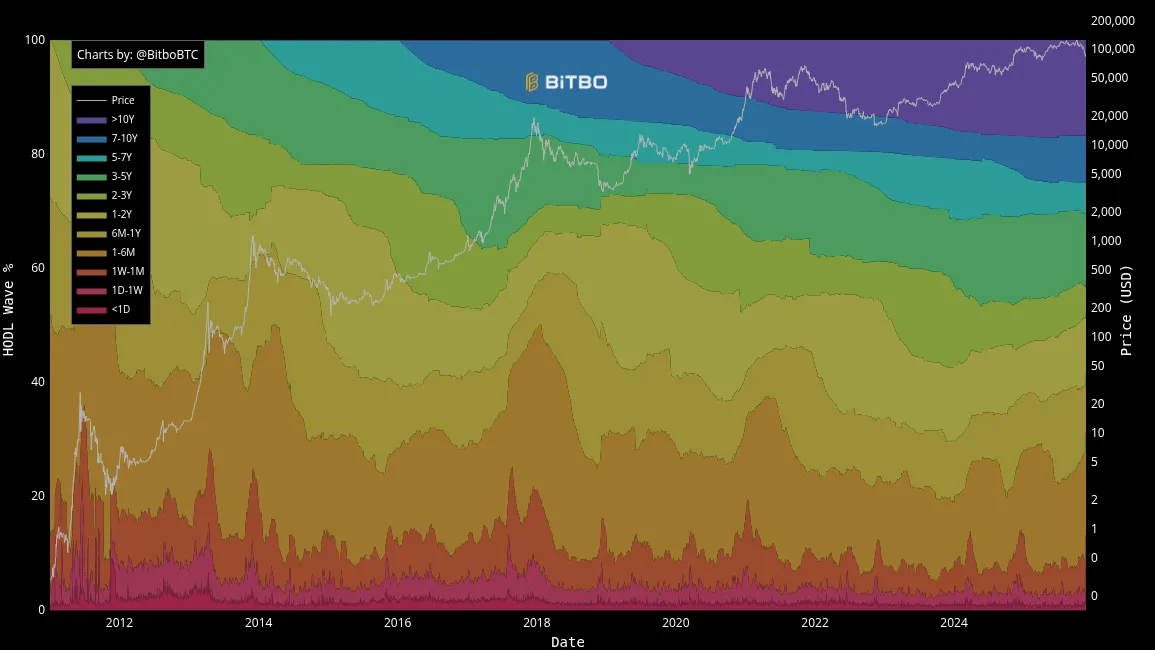
According to BitBo data, 32.4% of Bitcoins have not moved in five years, with 16.8% untouched for over ten years, 8.2% between seven and ten years, and 5.4% between five and seven years, raising discussions about how many of these are permanently inaccessible.
Check’s remarks followed comments from Ceteris Paribus, who noted that the challenges surrounding Bitcoin and quantum threats are fundamentally about consensus and not technology-specific issues. Paribus recognized that quantum-resistant solutions for Bitcoin could emerge, but highlighted the unique political implications for older coins.

Bitcoin hodl waves chart.
Check later indicated that the Bitcoin community might eventually need to allow old coins back into circulation rather than risk their theft by quantum attacks.
A Path Forward
The technological framework for rendering Bitcoin quantum-resistant is almost established, as the U.S. National Institute of Standards and Technology (NIST) has encouraged several post-quantum public-key cryptography methods that could be integrated into the Bitcoin protocol. However, current Bitcoin transactions still leverage vulnerable signature algorithms, which indicates a need for a new signature standard.
Experts generally believe that a backward-compatible upgrade to secure older addresses might be unrealistic for Bitcoin, contrasting with other blockchains that have developed such solutions. New quantum-resistant systems presented for platforms like Sui and Solana leverage different algorithms that are inherently more secure against quantum threats.
In conclusion, while the consensus problem presents substantial challenges for the Bitcoin community, addressing the quantum threat is crucial to its future.