Zcash: From Obscurity to November's Most Searched Cryptocurrency
Zcash has seen a remarkable surge in popularity, driven by halving events, increased privacy use, and an evolving governance model.

Key Highlights
- Zcash experienced a more than 10x increase in valuation over a few weeks, regaining its spot in the large-cap crypto sector with a market cap exceeding $10 billion.
- On Coinbase, Zcash (ZEC) emerged as the most-searched cryptocurrency in mid-November, surpassing Bitcoin and XRP.
- This uptick is fueled by several significant developments, including the 2024 halving, increased shielded balances, and the introduction of the NU6.1 holder-controlled funding model.
- Analysts are split; some argue this rise indicates a temporary peak, while others see it as a reevaluation spurred by growing interest in responsible privacy coins amid heightened AML regulations.
Zcash’s journey from being a low-key asset to a headline-maker is notable. For some time, it languished in the background, overshadowed by dominant coins like Bitcoin (BTC), Ethereum (ETH), and various memecoins.
However, November marked a shift. Zcash surged to the pinnacle of Coinbase’s search trends, garnering approximately 52,000 explicit searches, significantly outpacing XRP and Bitcoin, who had about 41,000 and 39,000 searches, respectively.
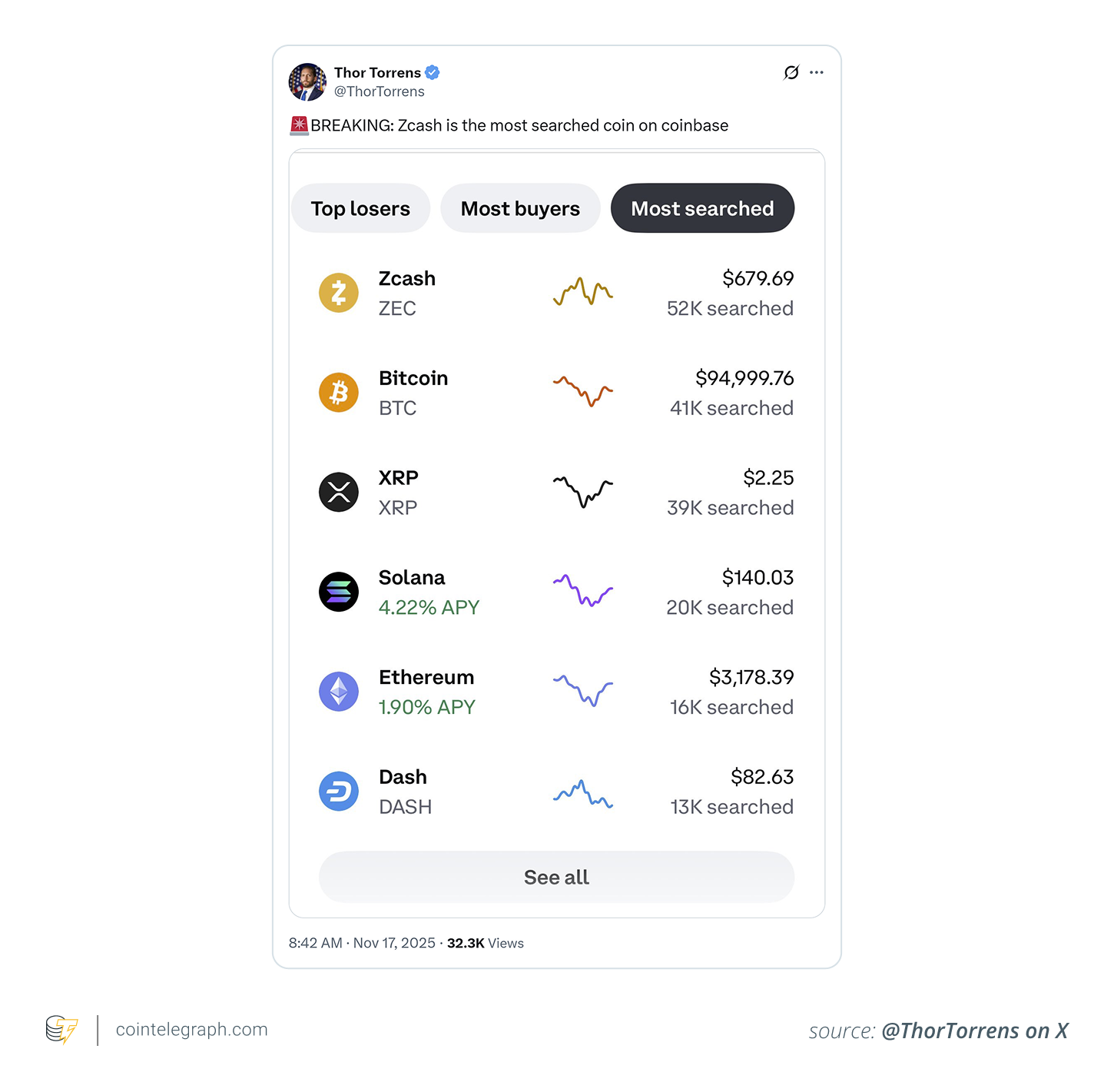 Zcash tops search charts on Coinbase
As ZEC’s price rallied over the past year, achieving gains in the four-digit percentage range, the question arises: what propelled Zcash’s transformation from an overlooked relic to a sought-out commodity?
Understanding Zcash’s Low Profile History
Initially launched in 2016 as a Bitcoin-like proof-of-work chain with a capped supply of 21 million coins, Zcash introduced groundbreaking zero-knowledge proofs, permitting transactions that are either transparent or entirely confidential.
Once viewed as a niche project supported by security experts and privacy advocates, Zcash’s prominence faded as scrutiny of privacy coins grew, leading to restrictions and delistings from major exchanges. During this period, the market share for ZEC dwindled, and activity declined significantly.
Despite enduring two halving events and various upgrades, by early 2024, Zcash seemed to be more of a historic token than a player in the current market narrative.
The Gradual Shift: Halvings and Increased Privacy Use
The recent surge seemed sudden but has been the result of two years of efforts to reshape Zcash’s core narrative. The latest halving on Nov. 23, 2024, reduced its block reward substantially, leading to discussions of ZEC as a sound money alternative.
Moreover, ZEC holdings in shielded addresses significantly increased from about 1.7 million to roughly 4.5 million coins in just one year, indicating users’ shift from mere speculation to actual usage.
The NU6.1 upgrade, which became effective on Nov. 24, 2025, allocated a portion of rewards to community grants and let ZEC holders have a say in developmental funding, solidifying Zcash’s place in the modern crypto ecosystem.
Resurgence Contents and New Regulations
The reemergence of interest was not coincidental; it coincided with events that underscored privacy’s importance. Following a serious breach in Monero, Zcash, with its governance and upgrade pathways, emerged as a viable alternative.
Regulatory pressure emphasizing AML compliance provided a favorable context in which Zcash could position itself as a more acceptable privacy option.
Overall, Zcash’s November surge encapsulates a broader trend in the crypto market, demonstrating that even forgotten assets can find rejuvenation when their economic fundamentals improve and the market narrative aligns with rising concerns about privacy.