

Quantum Security: The Emerging Priority for Layer-1 Networks
The Slow-Moving Threat that Blockchains Can’t Ignore
Quantum computers appear distant, mostly functioning as experimental machines with limitations in real-world applications. Yet, major layer-1 blockchain roadmaps are now prioritizing an important focus: post-quantum security.
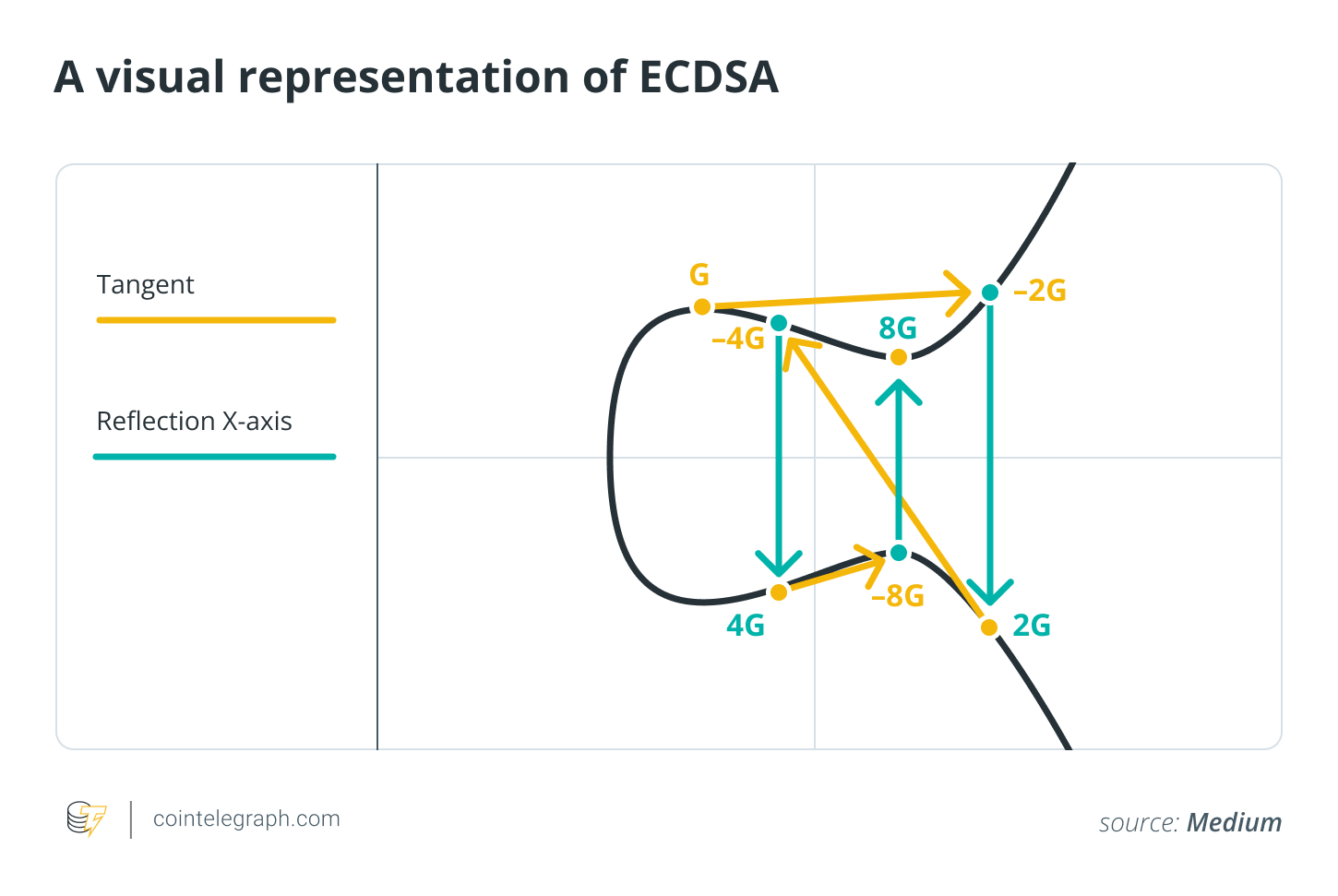
The threat is straightforward, though the mathematics can be complex. Blockchains heavily depend on elliptic-curve signatures (ECDSA and Ed25519) to verify that transactions originate from the rightful owner of a private key. A sufficiently advanced quantum computer, leveraging Shor’s algorithm, could theoretically obtain private keys from their public keys, allowing malicious actors to forge transactions.
A visual representation of ECDSA
There also exists a “harvest now, decrypt later” angle. Adversaries could capture public blockchain information now and bide their time for quantum technology to advance. This could endanger previously secure addresses and dormant wallets in the future, even if upgrades to safer algorithms occur.
Consequently, for public ledgers that are immutable, preparing for quantum threats is now essential. The National Institute of Standards and Technology (NIST) has begun publishing formal post-quantum standards, prompting layer-1 developers to view quantum safety as a looming risk, with some networks launching initial counteractions.
What Quantum Computers Actually Threaten in Crypto
Quantum computers don’t directly dismantle blockchains; instead, they disrupt specific algorithms.
A major focus for cryptocurrency is on public key signatures. Networks like Bitcoin and Ethereum utilize elliptic-curve algorithms to confirm transactions. A strong quantum computer could potentially recover these private keys, enabling fraudulent activity.
Nonetheless, not all systems are equally vulnerable. Hash functions like SHA-256 and Keccak are more resilient, as quantum search algorithms like Grover’s algorithm only provide a quadratic speed-up—a change that can largely be countered by increasing hash sizes and security measures.
Blockchains will need extensive cryptographic upgrades to uphold expected security levels amidst evolving standards, particularly concerning older unspent transaction outputs (UTXOs) in Bitcoin and signature-based randomness beacons in proof-of-stake (PoS) systems.
Moreover, transitioning cryptographic systems in essential infrastructures generally spans a decade or longer, necessitating proactive strategies from layer-1 projects long before quantum machines become a threat.
Why Quantum Security Just Jumped onto Layer-1 Roadmaps
Quantum risks have been an academic subject for years, but recent advancements have made them concrete agenda items for layer-1 developers.
Between 2022 and 2024, NIST began formalizing the first batch of post-quantum algorithms, including lattice-based designs such as CRYSTALS-Kyber for key establishment and Dilithium for digital signatures. This shift provided engineers a stable framework to guide their designs.
Governments and large entities have also begun discussing “crypto agility” and setting timelines through the 2030s for crucial systems. For public ledgers meant to hold assets and legal agreements across decades, ensuring alignment with these timelines is becoming a governance concern.
Layer-1 projects frequently respond to developments in quantum computing; each major hardware milestone sparks renewed interest in long-term security. Network teams are critically analyzing whether current signature protocols can endure the longevity of their projects.
Organizations should now be aware of the quantum-friendly migration trajectories suggested by entities such as the National Cyber Security Centre in the UK.
The First Wave: Which Layer-1 Networks are Preparing
A small number of layer-1 networks are moving beyond speculation to actionable plans focused on enhancing quantum resilience.
Algorand: State Proofs and Live PQ Transactions
Algorand stands out as a leading example, having introduced State Proofs—compact certificates for chain history verified through FALCON (a lattice-based signature chosen by NIST)—back in 2022. This initiative is quantum secure, validating Algorand’s ledger state periodically.
Recently, Algorand has demonstrated operational post-quantum transactions on its mainnet using Falcon-based signatures.
Cardano: Research-First Roadmap to a PQ Future
Although Cardano currently uses Ed25519, its founder, Charles Hoskinson, has framed quantum readiness as a strategic differentiator. The foundation has created plans integrating a distinct proof chain and post-quantum signatures synchronized with NIST’s Federal Information Processing Standards (FIPS).
Ethereum, Sui, Solana, and “Quantum-Ready” Newcomers
Research initiatives on Ethereum are working out post-quantum migration strategies, including new transaction types and mechanisms that allow for smoother transitions without disrupting the foundational protocols.
While Sui’s team is collaborating with academic institutions to devise a quantum-security roadmap, Solana has already introduced an optional quantum-resistant vault for users to safeguard high-value assets effectively.
Under the Hood: Why Going Post-Quantum Isn’t a Simple Swap
Shifting to post-quantum signatures might seem uncomplicated; implementing it on a global network is far from trivial.
The new algorithms introduce varying behaviors affecting everything from block sizes to user experience. Some of the primary candidates include:
- Lattice-based signatures, efficient but encumbered with larger keys compared to current elliptic-curve schemes.
- Hash-based signatures like SPHINCS+, reliable yet potentially bulky and limited in utility.
- Code-based methodologies, valuable for exchanges yet less frequently found in layer-1 considerations.
These design modifications lead to significant consequences for blockchain networks. Larger signatures result in heavier blocks, increased validator strains, and augmented storage needs, necessitating new infrastructures.
Finally, there’s the challenge of shifting legacy systems—billions of dollars rest in old addresses potentially abandoned by their owners, necessitating decisions on whether to pursue gradual transitions to quantum-resilient systems.
What Users, Builders, and Investors Should Watch Next
Quantum risks portend no immediate rush, yet they modify the criteria stakeholders use to assess a network’s enduring credibility.
Average users should monitor how their chosen ecosystems discuss adaptability in cryptographic systems. Over time, expect the emergence of hybrid signatures and new transaction formats to further enhance security protocols.
For developers, the emphasis must remain on flexibility to adapt to evolving standards. Enterprising designs that consider both current and future signature algorithms will more readily align with recommended practices.
Investors are encouraged to inquire about documented post-quantum plans for networks, examining whether live features exist or merely promotional language. Evaluating those proactive measures will increasingly become an integral component of technical due diligence in the industry.