



Insider Trading in Institutional Crypto Products
As the cryptocurrency industry evolves, Shane Molidor, CEO of the firm Forgd, warns that the longstanding issue of insider trading is now infiltrating institutional products, particularly digital asset treasuries (DATs).
The Growing Problem
Investors are reportedly taking advantage of prior knowledge regarding corporate cryptocurrency acquisitions, which raises significant concerns about price manipulation and market integrity. Molidor perceives these behaviors not merely as stray actions of a few individuals but as a prevalent characteristic within the cryptocurrency landscape. He argues that there is a noticeable disconnect between fair market values and actual prices, contributing to the emergence of front-running practices.
“In the West, it’s ask permission rather than forgiveness. In the East, it’s move fast, make as much money as possible and deal with the consequences later.”
This quote succinctly reflects the differing attitudes towards regulation and speed within Western and Asian cryptocurrency markets, according to Molidor. He notes that foundational players in the crypto realm often view compliance as secondary, which exacerbates the challenges faced by regulators.
Molidor, who has extensive experience in both Western and Asian trading environments, highlighted that retail traders remain largely oblivious to the strategies employed during token launches, which often favor price surges rather than true market discovery.
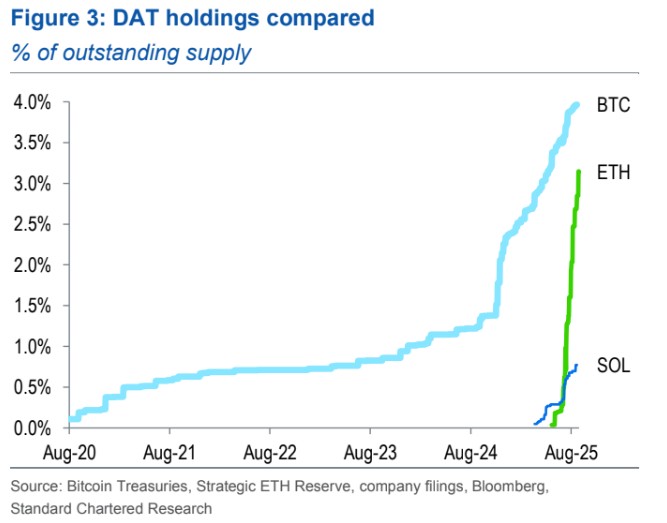 DATs Adjust to Market
DATs rotate to Ether and Solana as Bitcoin treasuries saturate. Source: Standard Chartered
DATs Adjust to Market
DATs rotate to Ether and Solana as Bitcoin treasuries saturate. Source: Standard Chartered
The Role of Exchanges
The practices at trading exchanges play a crucial role in moving prices artificially. Exchanges tend to underprice tokens at launch, maintaining thin liquidity. Small amounts of buying activity can result in significant price increases, leading retail traders to think they are entering at favorable costs.
“Everyone thinks they’re getting a fair and reasonable cost basis, but they’re not.”
According to Molidor, the market’s structure leads to poor user experiences over time when traders fall victim to price spikes driven by their buying actions.
Institutional Dynamics
The trends affecting DATs, which began with large-cap assets like Bitcoin, are shifting towards smaller tokens with high upside potential, making them more susceptible to speculative trading. The resulting environment is fraught with risks, as individuals working with institutional investors can leverage early insights for personal gain.
“What we’ve found with DATs is that the unspoken goal is often to trigger enough market impact to drive noticeable price appreciation.”
Demonstrating these dynamics, Molidor states that the thinness of liquidity can create scenarios where price drops are rapid once buying pressure decreases. The revelations from Molidor serve to remind stakeholders within the crypto space of the ongoing challenges of speculation and information asymmetry.
Conclusion
As the gap between traditional financial practices and the rapidly evolving crypto industry widens, the need for more robust frameworks grows. Molidor emphasizes that many projects still launch without adequate market strategies and that mutual understanding between tech innovators and institutional investors remains key. “When prices realign with true value, the potential for significant volatility becomes very real.”