
Analysis of Ether Price: Is a Continued Drop Expected in December?
Ether faces a potential decline toward $2,500–$2,200 as support weakens and bearish trends emerge.
Ether, the native token of Ethereum, is experiencing a continued downturn as it recently fell by approximately 30% over the last three months. This raises concerns regarding how much further the decline might extend as the year comes to a close.
Key Points:
- Ether might decline further to the range of $2,500 to $2,200 if support levels and technical patterns falter.
- However, the potential for a bullish breakout exists that could push the price back up to $3,550.
Market Analysis
According to market data, on Tuesday, Ether revisited its -0.5σ MVRV deviation band, hovering around the support level of $2,820–$2,830, for the second time within a week. This support has historically played a crucial role during downward trends. A key observation noted was that an earlier close beneath this support level had led to significant price drops.
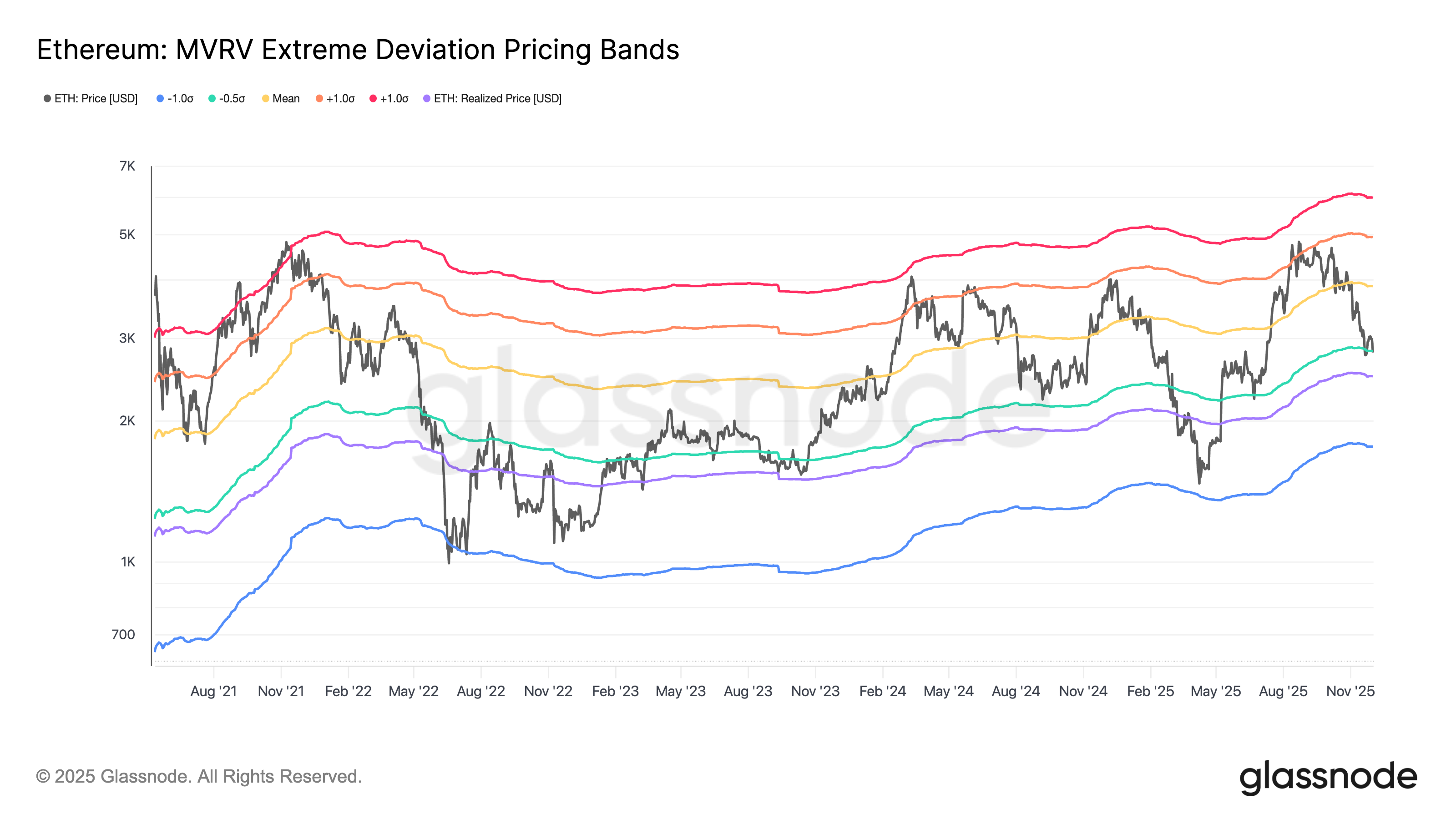 Ether MVRV deviation bands
Moreover, a confirmed breakdown below this critical support level could redirect attention toward the realized price of about $2,500, a figure that has often attracted market activity during corrections.
Bullish and Bearish Trends Ahead
The price of Ether has formed a bearish pennant on the daily chart, which often emerges after sharp downturns. Breaking below this pennant could lead to a further drop toward the $2,200–$2,220 range, nearly 20% below current prices. This zone corresponds with significant historical Fibonacci retracement levels.

If Ether manages to break above this pennant’s upper trendline, predictions suggest a rise towards $3,550 as we head into the new year. This trajectory aligns with forecasts from several analysts indicating potential price levels above $4,000, reinforcing the idea that Ether is currently undervalued.
This article does not constitute investment advice. Every investment choice comes with risks, and it is crucial for readers to perform their own due diligence.