
New EU Strategy Enhances ESMA's Role in Crypto Regulation
The European Commission has unveiled plans to extend the European Securities and Markets Authority's oversight over cryptocurrency firms and trading platforms, aiming to improve EU market competitiveness against the US.



The European Commission has suggested enhancing the authority of the European Securities and Markets Authority (ESMA) in terms of cryptocurrency and financial market supervision, aimed at bridging the gap with the United States.
Published on Thursday, the proposal aims to shift “direct supervisory powers” for crucial market infrastructures, such as crypto-asset service providers (CASPs), trading platforms, and central counterparties, to ESMA, thereby fortifying its coordinating function within the asset management sphere.
This proposal awaits approval from the European Parliament and Council, where discussions are currently ongoing.
If enacted, ESMA’s responsibilities in managing EU capital markets would closely align with the centralized system of the US Securities and Exchange Commission.
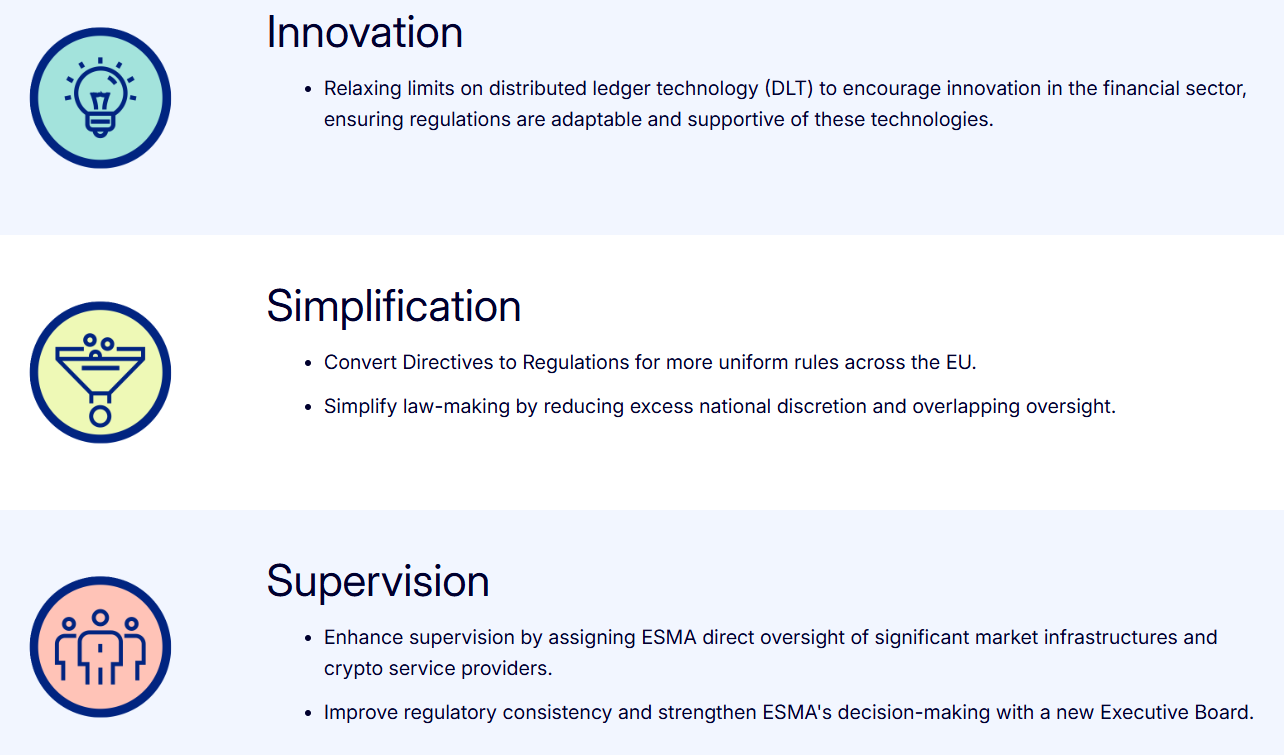 EU proposal seeks to streamline markets and enhance ESMA’s authority. Source: finance.ec.europa.eu
In September, France became the third country to advocate for ESMA in supervising major crypto firms, following Austria and Italy.
This action responded to rising criticism concerning Malta’s crypto licensing framework. In July, ESMA conducted a peer review of Malta’s Financial Services Authority, noting it only “partially met expectations.”
Amid worries about lenient regulations in certain jurisdictions, France also signaled its plan to block the “passporting” of licenses obtained from member states, raising enforcement concerns over the EU’s Markets in Crypto-Assets Regulation (MiCA).
The three EU nations also supported amendments to MiCA, proposing stricter regulations for crypto activities occurring outside the EU, improved cybersecurity monitoring, and a reassessment of regulations surrounding new token offerings.
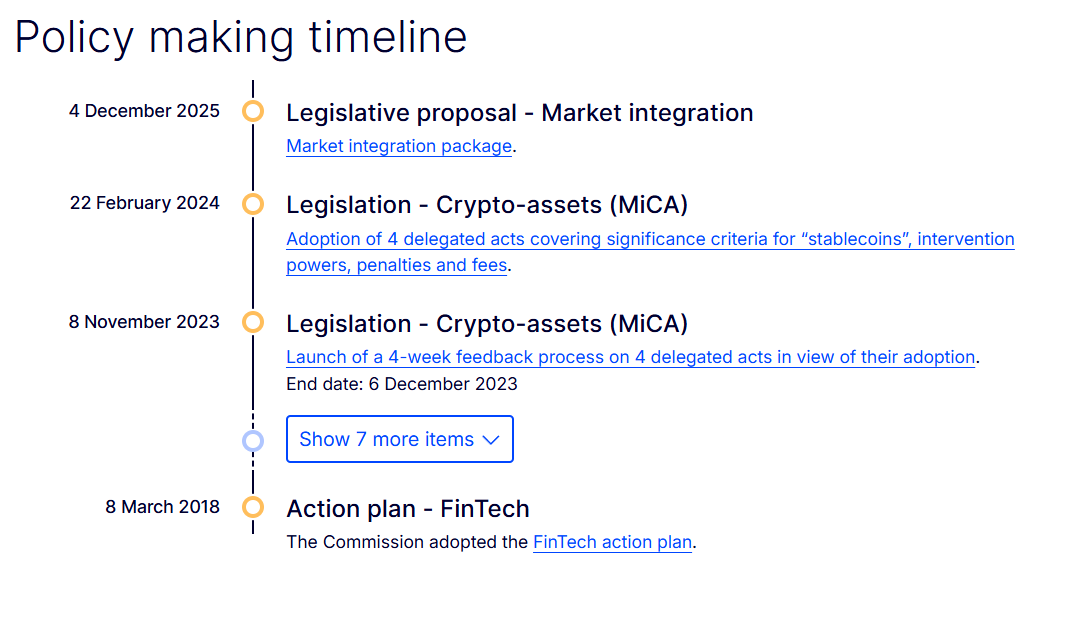 EU policy-making timeline: Source: finance.ec.europa.eu
“Creating a European SEC, for example, by extending the powers of ESMA, could be the answer. It would need a broad mandate, including direct supervision, to mitigate systemic risks posed by large cross-border firms,” said Christine Lagarde at the European Banking Congress in November 2023.
Industry experts warned that ESMA’s regulation over the entire bloc might stifle innovation, particularly for smaller crypto and fintech startups that depend on collaboration with national regulators.
“Centralizing authorization and supervision entirely within ESMA would require substantial human and financial resources, which could hinder decision-making and innovation, especially for newer players,” said Faustine Fleuret, head of public affairs at decentralized lending platform Morpho.
The wider initiative seeks to enhance wealth generation for EU citizens by making the union’s capital markets more competitive. As of 2024, the market capitalization of European exchanges represented only 73% of EU GDP, in stark contrast to 270% in the US, as outlined in a report by the European Commission.