
US Stablecoin Regulations Create Divergence in Global Liquidity, CertiK Warns
New regulations under the US GENIUS Act are leading to a split in global liquidity dynamics, contrasting with Europe's approach.



The implementation of the GENIUS Act in the United States is redefining global liquidity patterns and causing a notable divide from the European Union’s Markets in Crypto-Assets (MiCA) regulations. This report from CertiK details how separate liquidity pools are being established, thus leading to potential cross-border complications.
In 2025, the US digital asset market gained significant regulatory clarity, with a cohesive federal framework for the issuance, trading, and custody of digital assets.
Central to this regulatory shift is the GENIUS Act, enacted by President Donald Trump in July. This legislation outlines the first federal guidelines on payment stablecoins, imposing stringent reserve requirements and prohibiting yield-bearing stablecoins while integrating issuers into the national financial system.
Despite the clarity brought about for US issuers, CertiK cautions that these developments could further the divergence from Europe’s MiCA, thus establishing a unique liquidity pool and possibly resulting in fragmentation of the global stablecoin market.
Consequentially, it is anticipated that stablecoin liquidity will be increasingly divided by jurisdiction, leading to cross-border settlement friction and opening avenues for regional stablecoin arbitrage.
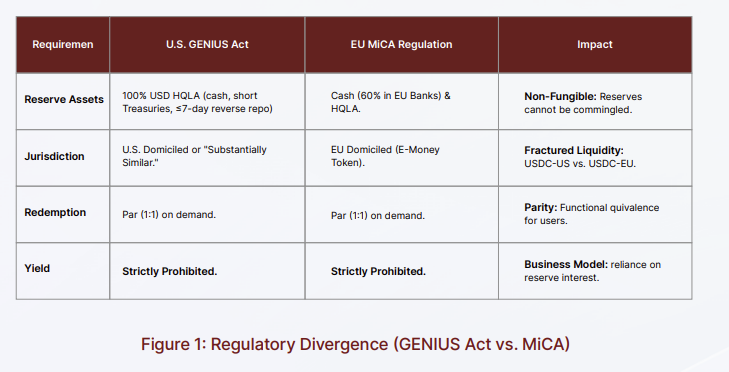 The regulatory divergence between the United States and the European Union concerning stablecoins. Source: CertiK
MiCA Faces Criticism Over Banking Vulnerabilities while US Approaches Stablecoins as a Tool of Statecraft
The EU’s MiCA framework, which parallels the US GENIUS Act by mandating full redemption at par and disallowing yield on stablecoins, has been criticized for increasing banking concentration risks, requiring most reserves to be maintained in EU banks.
Paolo Ardoino, Tether’s CEO, warned that this could potentially introduce ‘systemic risks’ for issuers, emphasizing that banks often utilize a significant portion of their deposits due to their fractional reserve lending practices.
Moreover, Anastasija Plotnikova, founder of Fideum, cautioned that MiCA might accelerate industry consolidation, raising entry barriers for smaller firms due to heightened compliance and capital requirements.
Yet, neither the GENIUS Act nor MiCA appear to aim at maintaining global fungibility for stablecoins. Both frameworks prioritize regulatory oversight and financial stability, with the US specifically working to reinforce dollar liquidity and the global usage of the dollar.
This sentiment was echoed earlier this year by Treasury Secretary Scott Bessent, who remarked that the administration intends to carefully strategize stablecoin oversight to extend the US dollar’s global dominance.
“As President Trump has directed, we are going to keep the US [dollar] the dominant reserve currency in the world, and we will use stablecoins to do that,” Bessent stated.