Ripple raised $500 million last November, reflecting a significant evolution for the company after its prolonged legal struggles with the U.S. Securities and Exchange Commission (SEC). This recent funding round has attracted notable Wall Street investors, driven by a proposed deal that offers unique investor protections and assured returns.
The investment, which valued Ripple at $40 billion, has been described as one of the highest worths for a privately held company. Heavy institutional players in this round included Citadel Securities, Fortress Investment Group, alongside funds from Galaxy Digital, Pantera Capital, and Brevan Howard.
New insights from Bloomberg revealed how Ripple was able to generate this attraction; primarily by structuring the investment with enhanced downside safeguards. Investors have the option to divest their holdings back to Ripple after three to four years for an annualized return near 10%. However, they lose this option should Ripple go public within that time frame.
Ripple also maintains the right to buy back the shares in that timeframe, potentially offering investors an even higher return of about 25% annually.
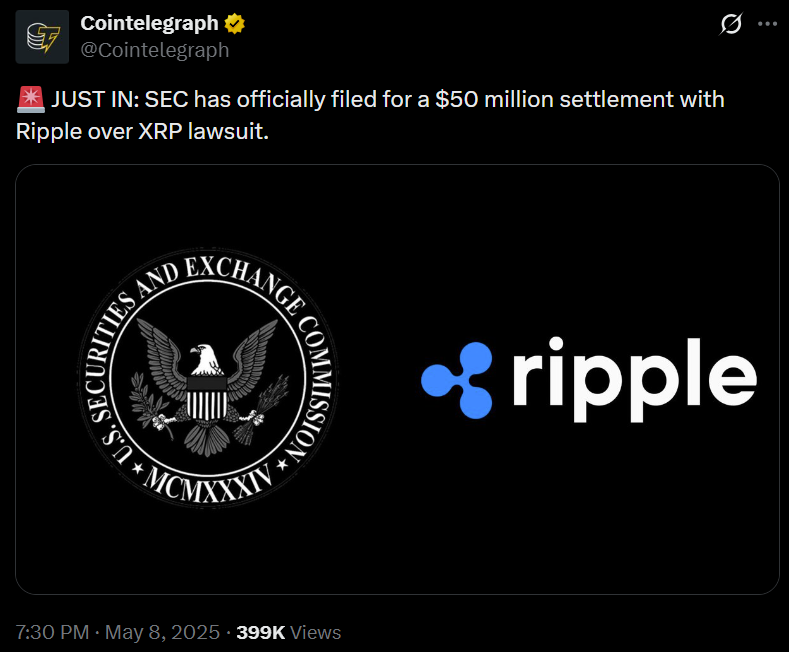 Ripple Funding
Source: Cointelegraph
Ripple Funding
Source: Cointelegraph
Despite expanding its initiative, including significant ventures into the stablecoin market with its dollar-pegged Ripple USD (RLUSD), some investors continue to associate their confidence in Ripple with the performance of XRP. As per Bloomberg, approximately 90% of Ripple’s net asset value is linked to XRP.
 Ripple USD Market Cap
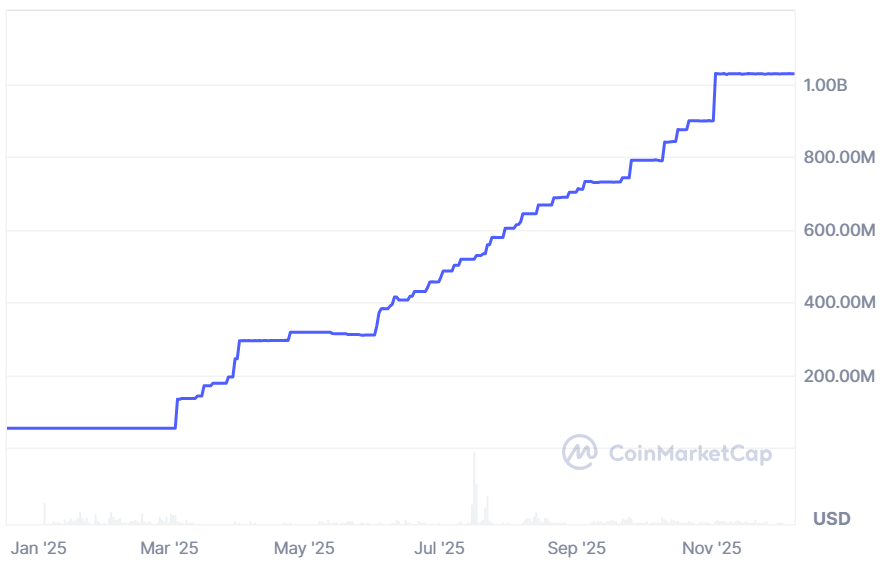
The Ripple USD stablecoin has achieved a market cap surpassing $1 billion. Source: CoinMarketCap
Ripple USD Market Cap
The Ripple USD stablecoin has achieved a market cap surpassing $1 billion. Source: CoinMarketCap
Ripple is positioning itself as a pioneer that merges custody, treasury, prime brokerage services, and stablecoins to facilitate institutional access to digital assets. Recently, the company acquired non-bank prime broker Hidden Road, now rebranded as Ripple Prime, and also purchased treasury-management firm GTreasury, totaling around $2.25 billion. These moves underscore Ripple’s ambition to establish a robust institutional framework.