
Solana Initiates Pilot for Quantum-Resistant Transactions with Project Eleven
Solana teams up with a security firm to trial quantum-resistant technologies in its testnet, claiming a scalable solution.


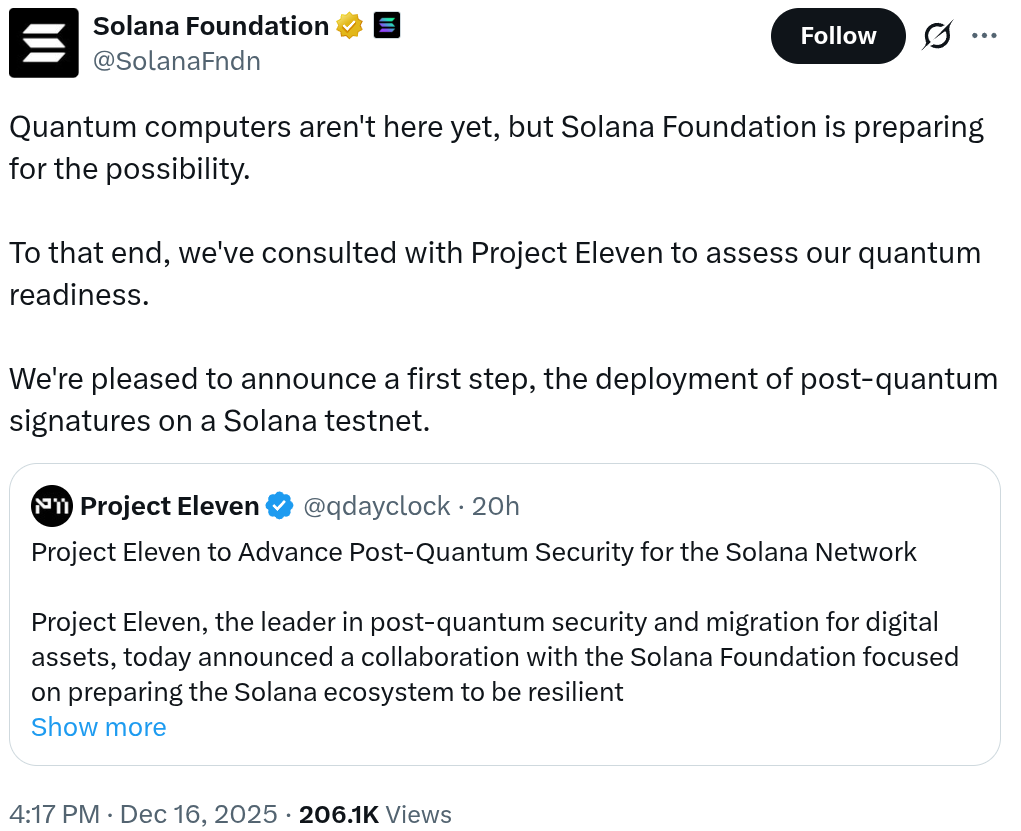
Solana has engaged in a partnership with Project Eleven, a firm specializing in post-quantum security, to evaluate quantum-resistant technologies on its testnet, asserting the promise of a scalable, complete solution.
This announcement comes as Project Eleven conducted a comprehensive threat assessment regarding quantum computing on Solana, creating a working prototype on the testnet that uses post-quantum digital signatures. The outcome illustrated that “end-to-end quantum-resistant transactions are both feasible and scalable.”
This claim is significant as post-quantum cryptography is predicted to be more resource-intensive than its traditional counterparts. By the time of this report, Solana had not issued a comment related to which post-quantum encryption standard the testnet utilizes.
On August 2024, the US National Institute of Standards and Technology (NIST) approved three post-quantum encryption standards: FIPS 203, 204, and 205. Cloudflare, a major internet infrastructure company, evaluated FIPS 204 against Ed25519 (which Solana relies on) and RSA-2048, determining that FIPS 204 required nearly five times the resources for signing while being quicker to verify than Ed25519. RSA-2048 proved to be slower for signing but slightly faster than FIPS 204 for verification.
 Source: Solana Foundation
Solana Foundation’s Vice President of Technology, Matt Sorg, emphasized their goal to protect digital assets from the risks posed by quantum computing. This concern appears to resonate across various significant crypto ecosystems.
Likewise, Ethereum co-founder Vitalik Buterin recently noted there is a 20% probability that quantum computers might undermine current cryptography before 2030. Not all specialists align with this timeline, as Adam Back, a cryptographer, expressed earlier that Bitcoin isn’t likely to experience a quantum threat for another 20 to 40 years.
Meanwhile, Ethereum has demonstrated a more agile developer response, which could prove beneficial in confronting this challenge.
In late November, James Check, the founder and lead analyst of Checkonchain, remarked that Bitcoin’s Bitcoint governance may encounter difficulties despite the technological solutions being largely settled for quantum resistance. He warned that consensus might be unattainable to freeze Bitcoin addressed that haven’t transitioned to quantum-resistant configurations—leading to a potential flood of compromised dormant Bitcoin in the market.