
Coinbase Follows Kalshi's Legal Strategy, Initiates Lawsuits Against Three States on Prediction Markets
Coinbase aims to establish federal oversight on prediction markets by suing regulators in three states, contending that federal commodities law should apply rather than state gambling statutes.





Coinbase has initiated legal action against regulators in Connecticut, Illinois, and Michigan, asserting that federal commodities law should govern prediction markets rather than state gambling regulations.
The cryptocurrency exchange is seeking to affirm that prediction markets operating on a platform recognized by the Commodity Futures Trading Commission (CFTC) should adhere to the Commodity Exchange Act (CEA) and not be subjected to varying state gambling laws.
In a post on X, Paul Grewal, the chief legal officer at Coinbase, stated that the company is pursuing this lawsuit to clarify that prediction markets are strictly under the jurisdiction of the CFTC, rather than individual state gaming authorities.
“We filed the cases to confirm what is clear: prediction markets fall squarely under the jurisdiction of the @CFTC, not any individual state gaming regulator (let alone 50).” “Hemos presentado los casos para confirmar lo que es claro: los mercados de predicción caen claramente bajo la jurisdicción de la @CFTC, no de ningún regulador de juegos estatal individual (y mucho menos de 50).”
Coinbase’s Legal Challenge Against State Gambling Regulations
Coinbase frames this legal dispute as not just legal in nature, but also structural. Their court documents indicate that if each state could independently determine the legality of prediction markets under federal oversight, the most stringent state laws would essentially become the national standard, disrupting the federalism framework.
Further, Coinbase highlights the legislative definitions within the CEA, emphasizing that Congress only specified a limited amount of commodities, excluding fields like sports or political outcomes from regulation.
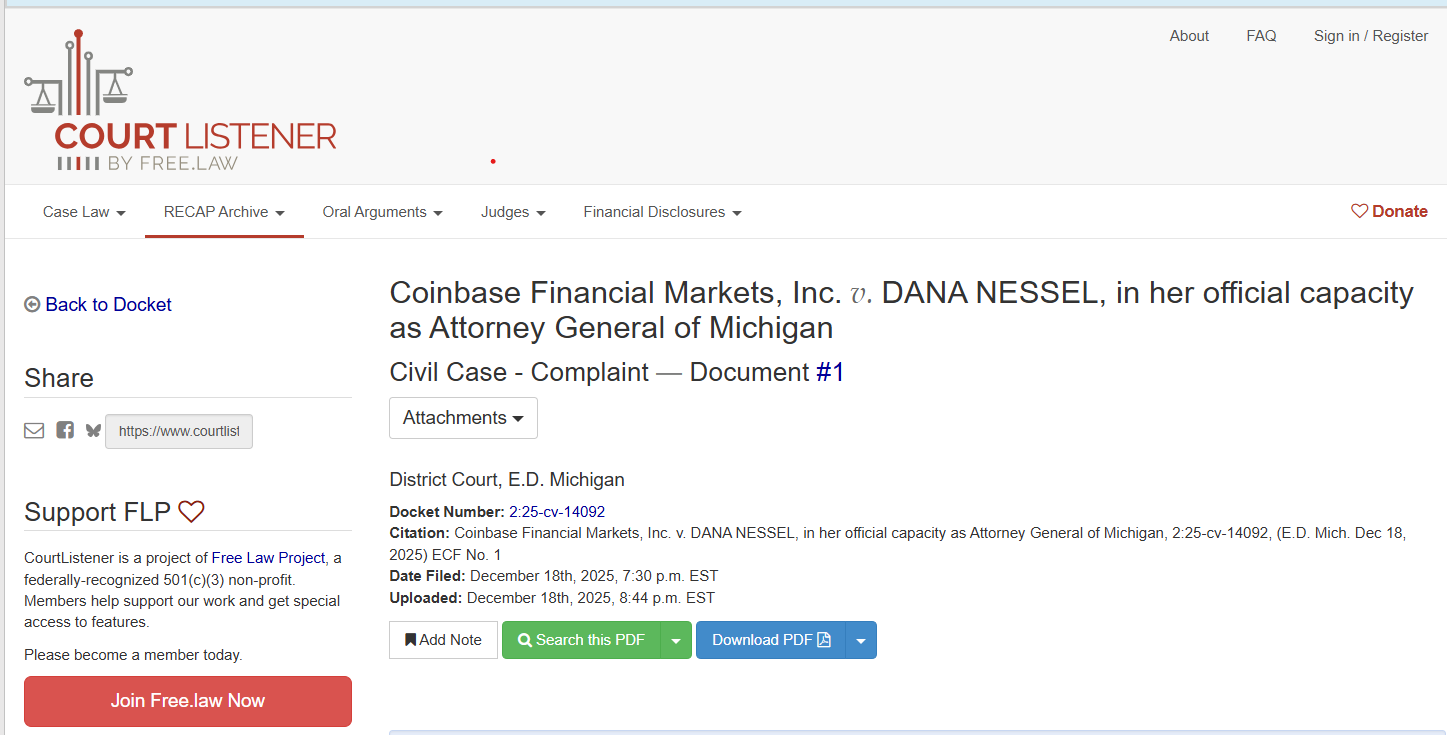 Coinbase filing against Michigan
Source: Court Listener
Grewal distinguishes between the function of Coinbase’s planned markets and traditional gambling establishments. He argues that casinos benefit from user losses and manipulate odds, while prediction markets merely facilitate transactions between buyers and sellers without bias.
This misclassification, Coinbase asserts, could jeopardize a federally regulated offering expected to operate under CFTC guidelines.
Kalshi’s Experience Highlights Risks for Prediction Markets
Kalshi, which operates as a CFTC-recognized market for event contracts, is currently embroiled in legal battles across multiple states regarding the classification of its markets as regulated financial products or illegal gambling activities. Initial court decisions have produced mixed outcomes, leading to higher stakes for both Coinbase and Kalshi in their ongoing efforts to define the legal landscape for prediction markets in the U.S.
With Coinbase adopting Kalshi’s legal strategy, they may drive federal courts to clarify whether U.S. prediction markets will be classified as regulated financial instruments or state-regulated gambling.