


Libya’s inexpensive, subsidized energy has ignited a clandestine Bitcoin mining boom that strains the national power grid, resulting in intensified government interventions.
Key Insights
- The low electricity prices in Libya made being profitable for even older Bitcoin mining hardware.
- At its height, Libya is believed to have contributed approximately 0.6% to the global Bitcoin hash rate.
- Mining activities exist in a grey area legally; while importing mining hardware is prohibited, there’s no definitive law covering mining operations.
- Authorities have linked these operations to power deficits and are actively increasing law enforcement actions.
In November 2025, Libyan authorities quietly delivered three-year prison sentences to nine individuals for conducting Bitcoin mining within a steel factory in Zliten. Equipment was confiscated, and illegally obtained profits were mandated to be returned to state coffers, marking a significant enforcement action that follows high-profile raids across cities like Benghazi and Misrata, which also resulted in the apprehension of numerous Chinese nationals involved in large-scale mining operations.
This unexpected growth was fueled by low-priced electricity and prolonged periods of regulatory ambiguity that allowed mining activities to flourish without oversight. By 2021, Libya, primarily recognized for its oil trade and frequent blackouts, managed to rank ahead of many Arab, African, and even some European economies, accounting for around 0.6% of the global Bitcoin hash rate.
As this article delves into how Libya turned into a hidden Bitcoin mining location, it will examine the consequences on its power infrastructure and what an increasing crackdown entails for Bitcoin miners in vulnerable economies.
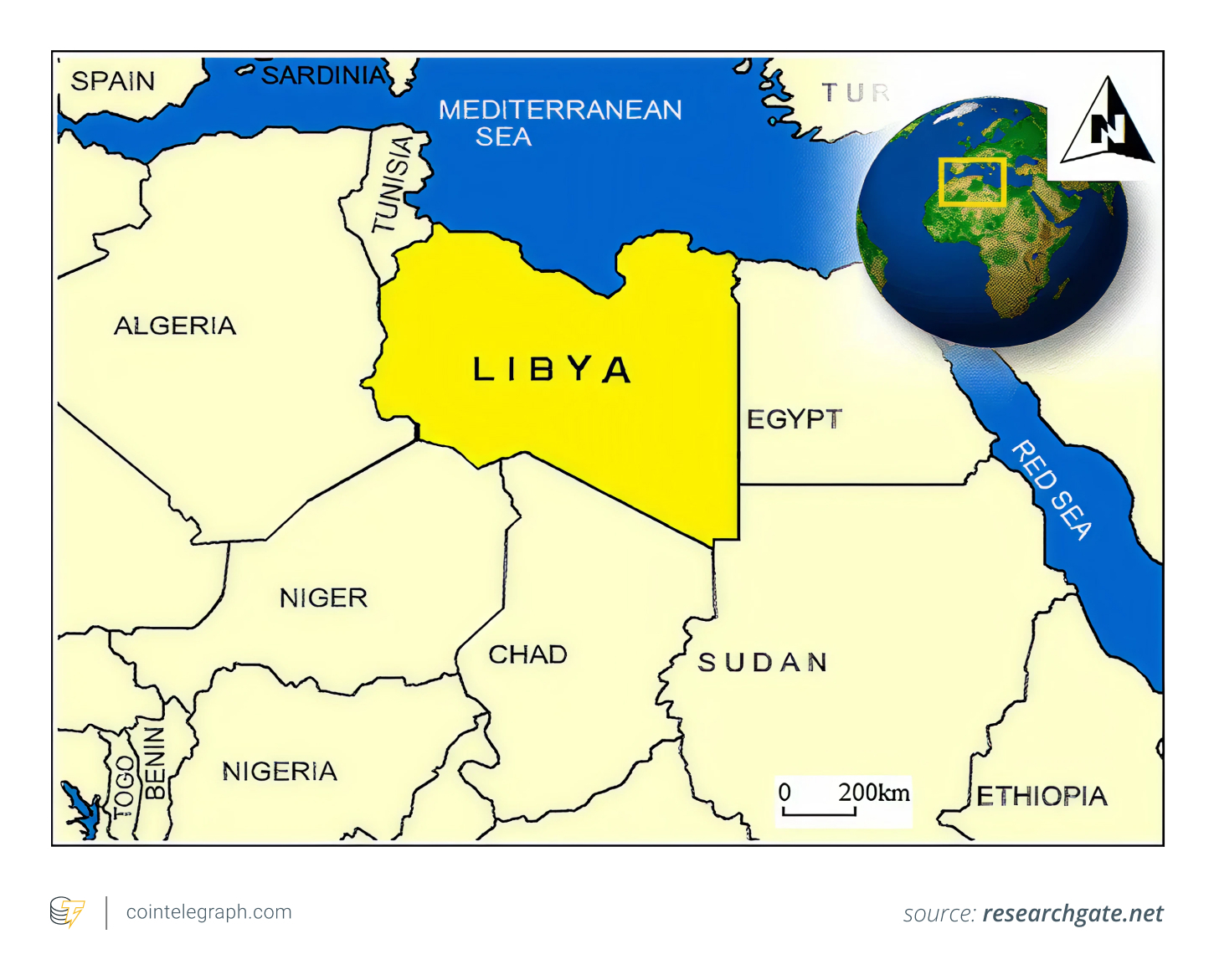 Image
Image
Did you know? Since 2011, Libya has faced challenges of multiple rival governments, militias, and shifting centers of power, resulting in periods where no single authority could adequately enforce cohesive energy or economic policies.
The Economics of Nearly Free Electricity
Libya’s mining surge begins with an impressive figure. Some evaluations suggest the country’s electricity costs around $0.004 per kilowatt-hour, making it one of the least expensive globally. This affordability stems from extensive state fuel subsidies and manipulated tariffs, even as the power grid suffers from decay and underfunding.
From an economic standpoint, such pricing presents significant opportunities for miners, who are acquiring energy for vastly less than its actual market rate and converting it into Bitcoin. For miners operating in Libya, this transition radically alters the scenario regarding hardware profitability.
Despite high costs in other markets necessitating the latest mining technology, older-generation machines that would be obsolete elsewhere still yield beneficial returns in Libya, provided they have access to subsidized energy. This makes Libya an attractive destination for foreign firms willing to take on legal and political uncertainties by importing used mining rigs.
Analyses indicate that at its peak—circa 2021—Bitcoin mining in Libya possibly accounted for about 2% of its overall electricity consumption.
In stable environments, such levels of consumption might be sustainable, but in Libya, where electricity outages are standard, the rerouting of subsidized energy towards privately managed mining operations poses serious ramifications.
 Image
Image
Did you know? Libya loses close to 40% of produced energy en route to homes due to issues within the grid, theft, and technical losses, according to the General Electricity Company of Libya (GECOL).
Inside Libya’s Mining Underworld
The reality of Libya’s mining surge diverges starkly from the sophisticated data centers typically associated with mining in places like Texas or Kazakhstan. Investigations from Tripoli and Benghazi uncover arrays of imported ASICs squished into deserted steel and iron facilities, warehouses, and fortified enclaves—often found on city outskirts or within industrial areas where high electricity usage goes unnoticed.
To evade authorities, some miners are purportedly employing methods such as cement pouring over sections of their operations to obscure heat emissions, complicating detection through thermal imaging.
As enforcement progresses, data indicates the rapid expansion of this underground economy, originating with the Central Bank of Libya labeling virtual currencies illegal back in 2018 citing concerns of money laundering and terrorist financing. Despite this, by 2021 it was estimated that Libya accounted for 0.6% of the global Bitcoin hash rate, outpacing countries in the Arab world and Africa.
Subsequent operations have revealed the extensive nature of these mining practices; in 2024, more than 1,000 devices were confiscated in Benghazi, believed to generate around $45,000 a month. The year prior, authorities apprehended 50 Chinese citizens and seized around 100,000 devices in one of the largest busts in Africa.
Legal experts assert that operators are relying on low electricity rates and disorganized governance to maintain their edge. Even with sizable farms being taken down, smaller installations scattered throughout homes and workshops are much tougher to detect.
Legal Ambivalence Surrounding Mining
Officially, Libya’s framework suggests an environment where Bitcoin should be virtually non-existent. In 2018, the Central Bank of Libya (CBL) announced that Bitcoin and similar virtual currencies are illegal, warning that users or traders would have no legal protection, citing money laundering and terrorism financing issues as justifications.
Still, seven years later, there’s no specific law that directly bans or permits crypto mining. As noted by legal analyst Nadia Mohammed, local laws have not expressly criminalized the act of mining itself; rather, miners often face prosecution for related activities—like unlawful electricity consumption, importing forbidden hardware, or using proceeds for other illicit activities.
Efforts have been made to close some regulatory loopholes. A Ministry of Economy directive issued in 2022 barred the importing of mining devices, yet such equipment continues to enter through smuggling and unofficial channels. The country’s cybercrime law hinges on defining cryptocurrency as a type of electronic currency, implicitly acknowledging its existence without firmly establishing the legality of mining it.
The Confrontation of Public Resources
Libya’s Bitcoin mining industry takes a toll on the same precarious electrical grid that supports hospitals, educational institutions, and residential areas, often only just. Pre-2022 estimations indicate areas of Libya experiencing power outages up to 18 hours daily, driven by infrastructural damages, cable theft, and chronic underfunding leading to demand outpacing dependable supply.
Illegal mining operations impose a steady, power-hungry requirement on this compromised grid, which officials estimate may consume as much as 2% of the nation’s power output—around 0.855 TWh annually. This redirected power is taken from vital services in a country where citizens routinely plan their routines around unexpected electrical outages.
Officials have attributed specific power demands to individual operations, claiming larger operations can draw between 1,000 to 1,500 megawatts—comparable to the energy consumption of several mid-tier cities. While some estimates may be exaggerated, they reflect genuine concerns within power companies about the constant energy draw posed by mining activities threatening advancements and potentially leading back to rolling blackouts, predominantly in summer.
Some commentators draw parallels between the crackdown on mining and an overarching energy and water dilemma wherein subsidized fuel, illegal connections, and climate-related stress already pressurize the system. Consequently, every narrative involving clandestine rigs using inexpensive, subsidized electricity to generate Bitcoin income risks inciting public disenchantment, especially when residents cope without power while these operations persist.
The Path Ahead: Regulation or Elimination?
Policymakers in Libya now face division over how to handle an industry that clearly operates, evidently utilizes state resources, yet lives within a legal gray area. Economists advocating for regulation suggest that the authorities accept mining’s reality and move towards licensing, metering, and taxing it. They reference Decree 333 from the Ministry of Economy, which outlawed the importation of mining devices, as evidence that officials recognize the industry’s magnitude and imply that a regulated sector could generate foreign currency and create job opportunities for the Libyan youth.
Conversely, finance professionals and compliance experts argue that mining’s association with electricity theft, smuggling, and money laundering risks staunchly justify a more cautious approach. Unity Bank’s systems director has urged the Central Bank to enhance regulations, citing that the advancing adoption of crypto—approximately 54,000 Libyans or 1.3% of the population were crypto holders by 2022—outpaces the current safeguards.
This conversation transcends Libya’s borders. Across various regions in the Middle East, Africa, and Central Asia, the recurring theme emerges: cheap energy, weak institutions, and a thriving mining sector.
Analysts from CSIS and EMURGO Africa caution that without credible governance and sustainable energy pricing, mining could worsen energy crises and complicate relationships with lenders like the International Monetary Fund (IMF), despite appearing to be easy profit on paper.
For Libya, the critical challenge lies in shifting from reactive crackdowns and import bans to a solid decision: either absorb mining into its economic and energy framework or enforce a consistent shutdown of operations.