
Bitcoin's Price Struggles Amid Weaker U.S. Economic Indicators
Investors are shifting to safer assets as Bitcoin struggles near $90,000 due to disappointing U.S. jobs data and macroeconomic conditions.



Bitcoin remains close to the $90,000 mark as investors respond to disappointing U.S. job statistics and a decelerating economy, leading them to safer asset classes.
Key Points:
- A strong demand for U.S. Treasurys and diminishing expectations for a Federal Reserve rate cut signal a trend towards safer investments, which diminishes interest in Bitcoin.
- Economic downturns, especially in Japan and lesser job figures in the U.S., put pressure on Bitcoin, affecting its role as a hedge in the near future.
Despite consistently failing to stay above $92,000 for the past month, market participants are devising various theories to explain the price decline. Some traders claim it’s market manipulation, while others cite growing concerns regarding the artificial intelligence sector, even though substantial evidence is lacking to validate those claims.
The S&P 500 was trading just 1.3% below its peak last Friday, whereas Bitcoin is approximately 30% below the $126,200 threshold it achieved in October. This discrepancy illustrates a trend of risk aversion among traders and challenges the narrative that worries over an AI bubble are influencing broader market weaknesses.
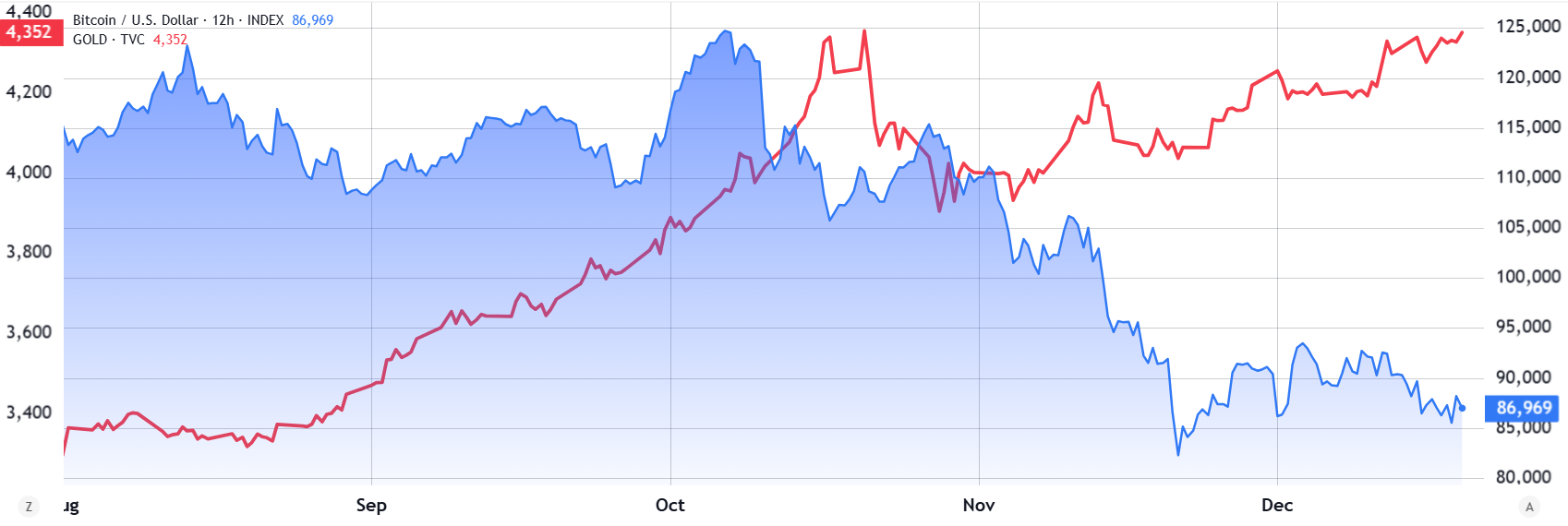 Bitcoin vs Gold
Gold/USD (left) vs. Bitcoin/USD (right). Source: TradingView
Bitcoin vs Gold
Gold/USD (left) vs. Bitcoin/USD (right). Source: TradingView
Job market deterioration and declining consumer data are causing traders to rethink their expectations of the Federal Reserve. In retail, businesses like Target and Macy’s are lowering earnings projections, and Nike experienced a 10% drop in shares recently, reflecting a bearish market environment.
As of now, the probability of an interest rate cut at the Federal Open Market Committee (FOMC) meeting on January 28 has decreased from 24% to 22%. Continuous firm demand for U.S. Treasurys is evident, with a 10-year yield resting at 4.15%.
Bitcoin’s linkage with traditional markets is on a decline, yet this does not mean that cryptocurrency investors are secure from economic downturns. The financial landscape continues to change, with Japan’s 2.3% GDP decline in the third quarter marking a significant shift. As the risk appetite diminishes, the effectiveness of lower interest rates and stimulus on assets perceived as risky is waning, making Bitcoin less likely to serve as an alternative hedge in the immediate future.