



Ethena’s synthetic dollar, USDe, has faced a drastic reduction in market capitalization, losing approximately $8.3 billion in net outflows since the significant liquidation event on October 10. Investor confidence in leveraged and synthetic collateral structures has been faltering.
According to a report from 10x Research, the October downturn marked a pivotal moment for the cryptocurrency market, transitioning from a bullish phase to one of deleveraging. This crash led to an estimated loss of $1.3 trillion in overall market value, which was nearly 30% of the total capitalization back then.
The USDe stablecoin, relying on synthetic collateral rather than traditional fiat reserves, saw a ‘sharp loss of confidence’ under these turbulent conditions, as noted by analysts.
Data from CoinMarketCap indicates that USDe’s market cap was approximately $14.7 billion on October 9, but this figure plummeted to roughly $6.4 billion in just over two months.
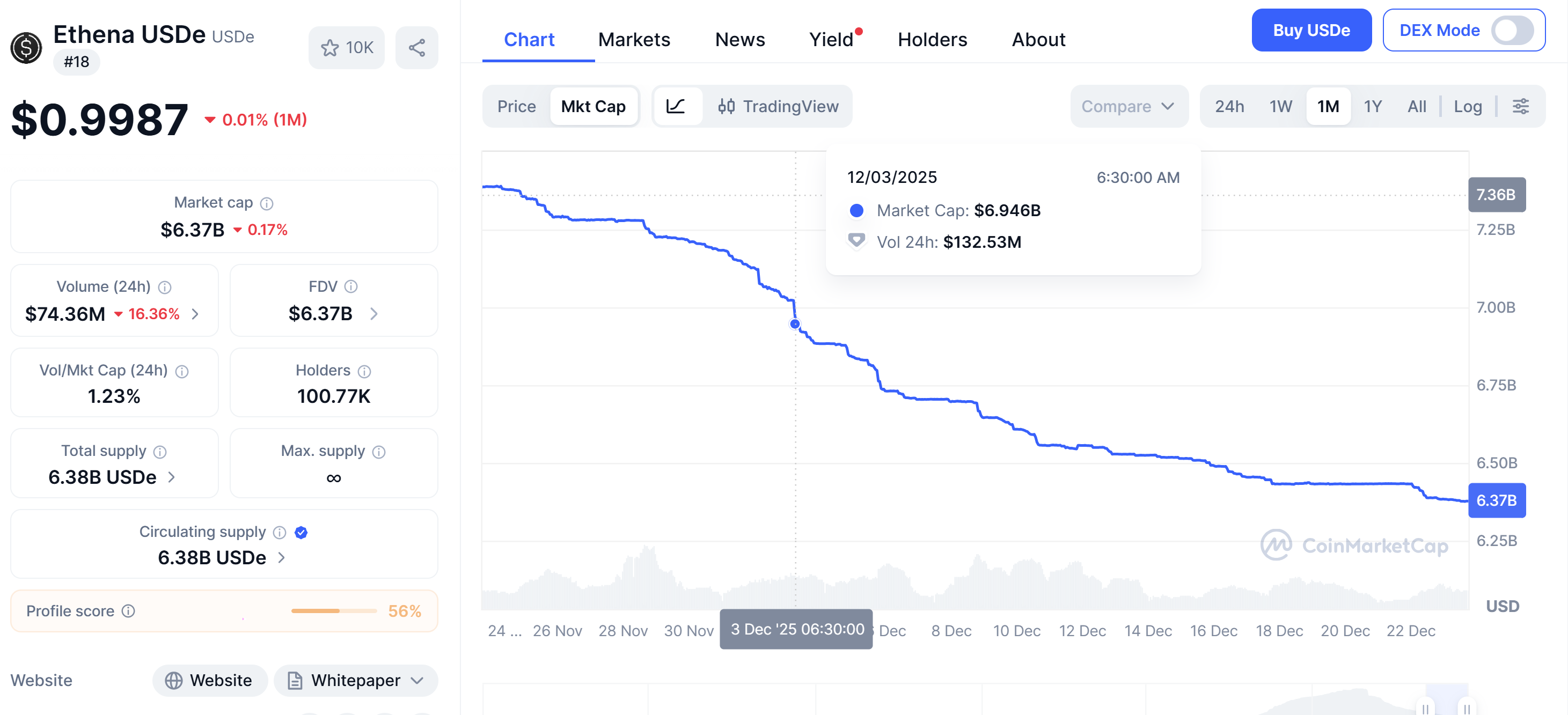 USDe’s Market Cap Declines
USDe’s market cap declines. Source: CoinMarketCap.
USDe’s Market Cap Declines
USDe’s market cap declines. Source: CoinMarketCap.
Brief Price Peg Loss of USDe
After the October crash, USDe temporarily slipped below its pegged rate, falling to around $0.65 on Binance. According to Guy Young, the founder of Ethena Labs, this brief deviation was attributed to an internal oracle issue on the exchange, not related to the stablecoin’s collateral or redemption framework. He confirmed that USDe minting and redemption processes operated smoothly during the crash, with around $2 billion redeemed across major DeFi platforms within 24 hours and only minor price discrepancies elsewhere. As of now, USDe trades at $0.9987, according to CoinMarketCap.
The October 10 crypto market crash marked the largest liquidation event recorded in cryptocurrency history, with over $19 billion in crypto positions liquidated, leading to a $65 billion drop in open interest, according to CoinGlass.
Stagnation of Crypto Market Activity
The aftermath of the crash has also seen a downturn in broader market activity, with crypto trading volumes decreasing by about 50%. Additionally, US-listed Bitcoin exchange-traded funds (ETFs) recorded around $5 billion in net outflows since late October.
10x Research emphasizes that this ongoing weakness stems from a calculated pullback by regulated capital instead of retail capitulation. As leverage and liquidity diminish, Bitcoin has started to behave more like an isolated risk asset rather than a macro hedge.