


Public companies and treasury firms in the cryptocurrency sector are increasingly embracing Ether staking as a form of passive income. Sharplink Gaming, recognized as the world’s second-largest corporate holder of Ether (ETH), reported earning 10,657 Ether, valued at $33 million, through staking activities over the previous seven months, as shown on the company’s dashboard.
Staking allows investors to earn returns by locking their tokens to secure proof-of-stake blockchain networks.
According to SharpLink, recent staking operations have provided an estimated $1.4 million in value for shareholders within the past week. The company emphasized, “Our plan remains consistent: 100% ETH and 100% staked,” as noted in a post on X earlier this week.
 SharpLink staking rewards chart
SharpLink staking rewards, all-time chart. Source: SharpLink
Expansion of Yield Strategies by SharpLink
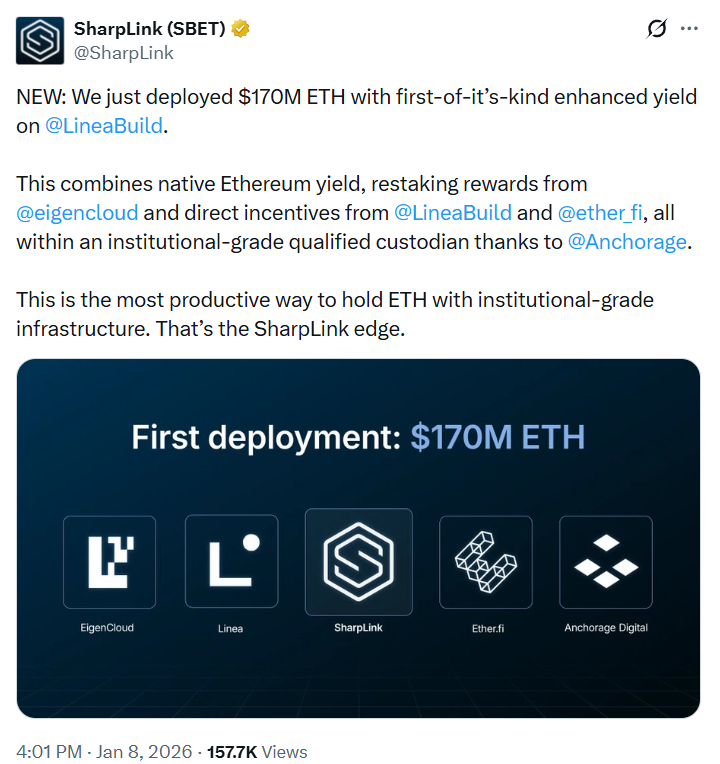
SharpLink has invested an additional $170 million in Ether into the Ethereum layer-2 solution known as Linea to enhance their staking returns.
This new strategy combines native staking rewards with restaking incentives from Linea and associated protocols. The initiative, announced in October, is safeguarded through institutional mechanisms by Anchorage Digital Bank, SharpLink’s custodian.
 Source: SharpLink
Institutional Shift Towards Crypto Staking Yields
Competitor BitMine Immersion Technologies, the leading corporate Ether holder, has intensified its staking efforts, with over 936,512 Ether staked, equivalent to roughly $2.87 billion as of recent reports.
SharpLink has staked a total of 864,840 Ether, aligning with their overall holdings, acquired at an average token price of $3,609, as indicated by their dashboard.
An increasing number of institutions are entering Ether staking, including Morgan Stanley, which recently filed to introduce a spot Ether exchange-traded fund to harness more staking gains. This uptick in institutional involvement indicates that cryptocurrency staking is evolving from a relatively niche decentralized finance (DeFi) experiment into a more mainstream yield-generating tactic utilized by companies.