


South Korea’s Supreme Court has made a landmark decision, ruling that Bitcoin stored in centralized exchanges can be seized by law enforcement agencies. This ruling, disclosed via the court’s official bulletin, indicates that Bitcoin is considered an “object of seizure” under the Criminal Procedure Act.
In a recent case, the court approved the confiscation of 55.6 Bitcoins held in a local exchange account related to a money laundering investigation. The ruling emphasized that Bitcoin possesses independent manageability, tradability, and economic value, qualifying it for seizure.
The decision aligns with similar enforcement practices observed in the United States and European Union, where authorities have the right to seize cryptocurrencies from centralized platforms during criminal proceedings.
This ruling clarifies the legal status for South Korean users storing Bitcoin on platforms such as Upbit and Bithumb, introducing the possibility of freezing and seizing assets linked to alleged criminal activities at the exchange level. Furthermore, it pressures exchanges to enhance compliance with Know Your Customer (KYC) regulations and cooperation with law enforcement.
The Supreme Court’s decision also of a broader discussion amongst regulators in South Korea, who are contemplating additional measures to strengthen the oversight of cryptocurrencies, ensuring such actions prevent market manipulation and other illicit activities.
Related: Bitcoin ETF momentum builds in South Korea as regulation lags behind
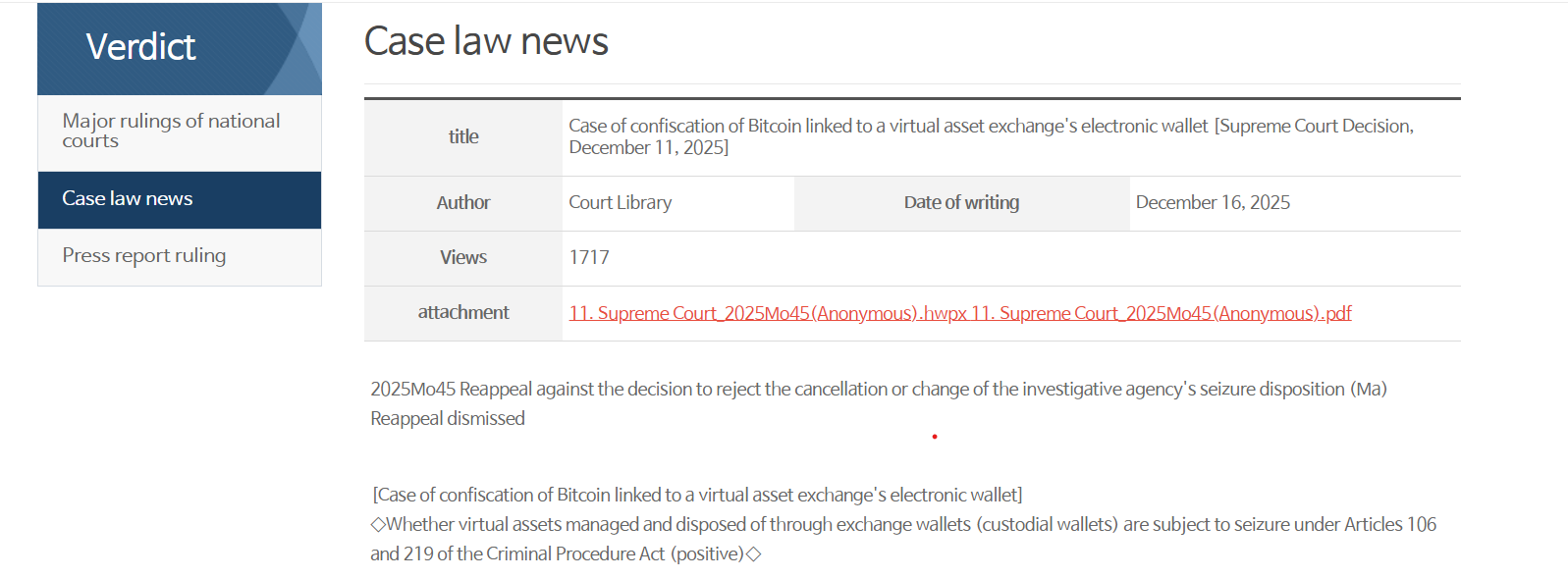 Supreme Court Ruling. Source: Court of Korea