


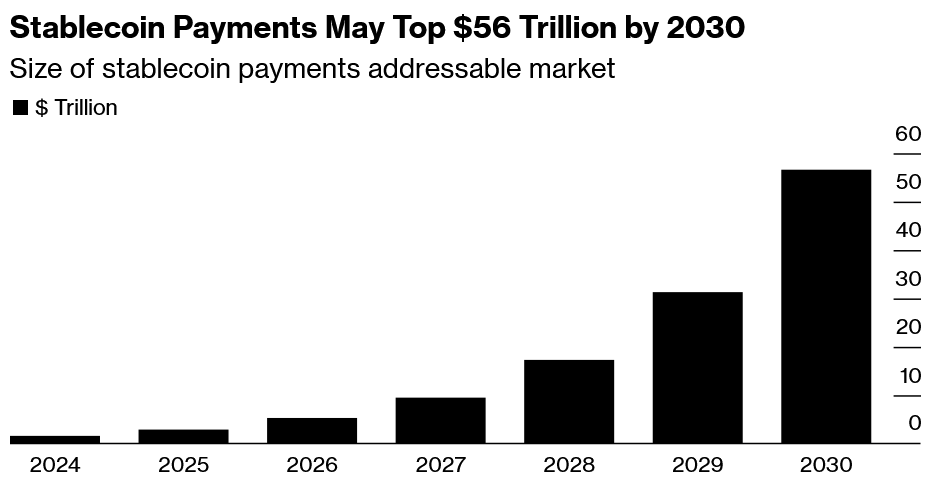
Recent insights from Bloomberg indicate that stablecoin transactions could soar to approximately $56 trillion by 2030. This staggering increase is attributed to heightened adoption by both institutions and nations coping with economic uncertainties.
In 2025, transaction volumes were reported at $2.9 trillion, pointing to a projected annual growth rate exceeding 80% if these forecasts hold true, driven by the demand for stablecoins amidst rising inflation and political instability.
 Stablecoin Image
USDT Leads Central Finance, While USDC Dominates Decentralized Finance
Tether (USDT) remains the leading stablecoin for daily transactions and savings, while Circle’s USDC is gaining traction on decentralized finance platforms.
The increase in stablecoin usage by 81% year-over-year in 2025 marks a notable trend, even though there has been a decline in volume on decentralized platforms, as reported with data from Artemis, with Anthony Yim noting the ascent of US dollar stablecoins in emerging markets experiencing geopolitical instability.
Despite the market shift, USDC reported a transaction volume of $18.3 trillion in 2025, more than USDT’s $13.3 trillion. Together, they contributed over 95% of a record $33 trillion in transaction volumes last year—an impressive 72% increase compared to the previous year.
At present, the stablecoin market valuation stands at $312 billion, with projections by the US Treasury estimating it could reach $2 trillion by 2028.
Growth at the Nation-State and Institutional Level
With the recently enacted GENIUS Act, countries like Canada and the UK are poised to implement stablecoin frameworks by 2026, indicating a potential global trend toward incorporating stablecoins into standard financial systems. Additionally, platforms such as Western Union are set to launch a stablecoin settlement system on Solana in the first half of 2026.
Although the future holds great promise for stablecoins, the financial landscape continues to evolve rapidly.