
KYC is Essential to Combat Insider Trading in Prediction Markets, Says Messari
A recent discussion highlights the challenges of preventing insider trading in non-KYC prediction markets while suggesting that implementing identity checks can enhance oversight.



Concerns about insider trading in prediction markets are rising, especially following notable bets on geopolitical events. This raises significant doubts regarding the effectiveness of regulation in this expanding sector.
Preventing insider trading may only be feasible on prediction markets that apply Know Your Customer (KYC) measures, according to Austin Weiler, a research analyst from Messari.
“For KYC-compliant platforms, a crucial approach is to limit users’ access to particular markets initially,” Weiler informed Cointelegraph. He emphasized that state representatives could be barred from accessing political or geopolitical markets.
However, he pointed out that this does not completely eradicate malpractice, as insiders might still relay information to outside parties, though it does create a significant barrier and elevates enforcement requirements.
The Challenges of Non-KYC Prediction Markets
Enforcement in non-KYC prediction markets is particularly daunting, sometimes described as “almost impossible,” as noted by Weiler. When cryptocurrency wallets are not associated with identifiable individuals, tracking traders or verifying access to sensitive non-public information becomes nearly impossible.
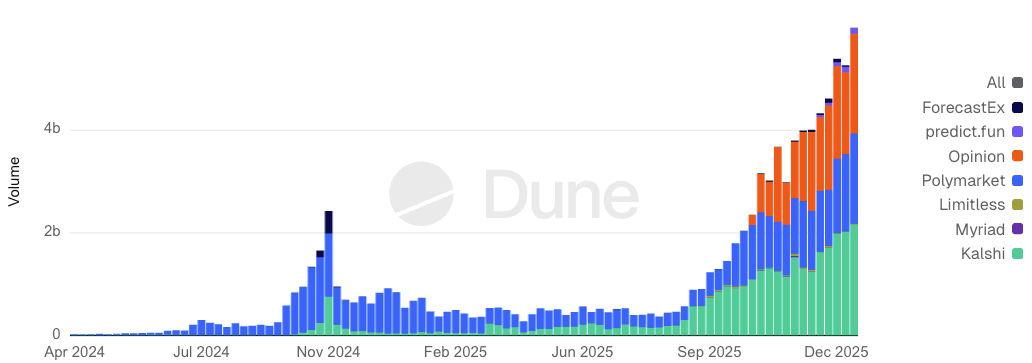 Trading volumes reach $6 billion in prediction markets by January 2026. Source: Dune
Weiler explained, “Some prediction markets may monitor atypical trading patterns, limit trade volumes, or reduce trading during key geopolitical events. Nonetheless, these precautions can be easily sidestepped.”
“Bans directed at government officials are practically enforceable only in systems backed by KYC. Although all on-chain activities are visible, transparency does not resolve the attribution dilemma. Without proper identity verification, linking a wallet to a specific official or insider with certainty is exceedingly hard.”
KYC Requirements Across Major Platforms
Currently, KYC standards differ greatly among major prediction platforms like Kalshi and Polymarket, while decentralized alternatives often do not mandate identity checks.
Kalshi adheres to KYC requirements under the oversight of the U.S. Commodity Futures Trading Commission. Its sign-up process includes gathering basic personal information, with potential requests for additional ID verification.
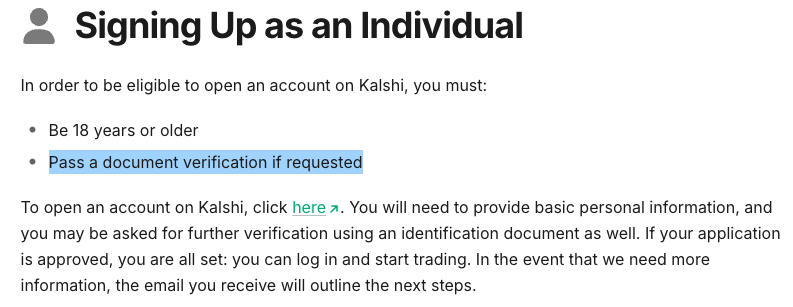 Sign-up webpage for Kalshi. Source: Kalshi
Polymarket requires KYC for U.S.-based users, while non-U.S. versions are reported to operate without compulsory identity checks, often accessible via VPN, though this is not officially acknowledged in their user documentation.
Recent media scrutiny highlights significant prediction market platforms amidst reports of anonymous trades connected to geopolitical occurrences, such as a trader transforming $30,000 into over $400,000 prior to the capture of Nicolás Maduro, Venezuela’s former president.
Legislation is being considered, including the Public Integrity in Financial Prediction Markets Act of 2026, which seeks to restrict government officials from participating in such markets when they have access to sensitive nonpublic information.