
Ethereum cofounder Vitalik Buterin has announced that 2026 will be pivotal for regaining control over self-sovereign computing, emphasizing his commitment to a personal tech stack that favors privacy and decentralization.
In a recent post on X, he shared the software adaptations he’s implemented to steer clear of data-intensive centralized services.
The two significant adjustments he made in 2025 include a complete transition to Fileverse, a decentralized document platform akin to a more private Google Docs, as well as an intentional shift to using Signal for communications.
Signal provides end-to-end encryption by default, ensuring that minimal metadata is retained, including basic information like account creation time and the last connection date.
In contrast, Telegram only offers strict encryption in optional “secret chats” while retaining both messages and metadata on its servers, which has come under fire as requests for data from law enforcement have surged in certain areas like France.
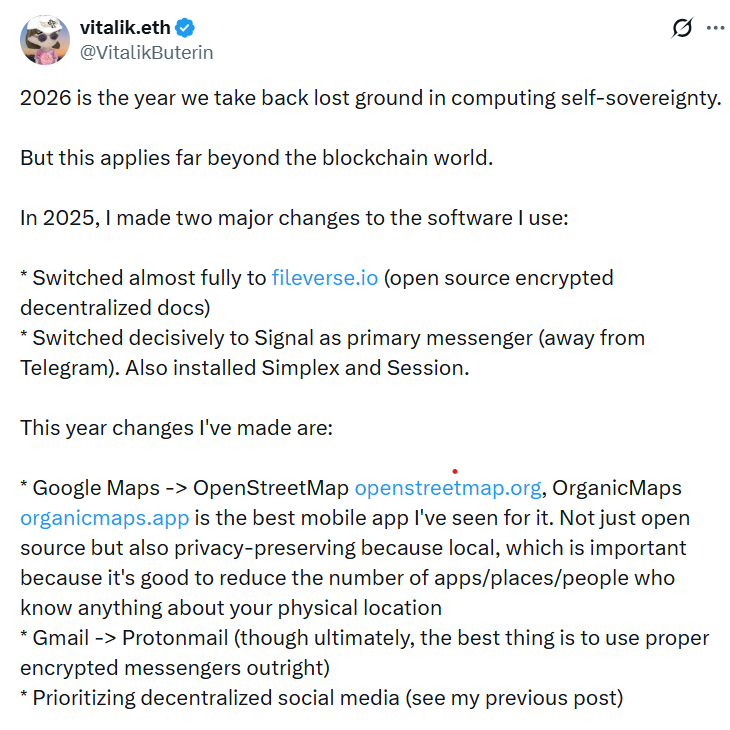 Becoming more self-sovereign. Source: Vitalik Buterin
In 2026, he will transition away from Google Maps for navigation, opting for OpenStreetMap via OrganicMaps, and will also leave Gmail behind for Proton Mail, placing focus on decentralized social media platforms.
Buterin has also engaged in testing the feasibility of running large language models locally, indicating that the practice of sending all data to external servers is becoming obsolete as users can now increasingly rely on their hardware for AI tasks. He acknowledges that while improvements in usability and seamless integration are still required, substantial progress has been noted compared to previous years.
His advocacy for locally hosting models is resonating, especially with individuals like Naomi Brockwell, who have long positioned local running of models as the most private AI utilization method without transferring data to remote servers.
Brockwell has consistently advocated for behaviors that enhance privacy, emphasizing that true privacy would re-establish user autonomy while encouraging the adoption of tools like Bitcoin, encrypted messaging, and self-hosted services to counteract government overreach and corporate surveillance.
As global discussions intensify regarding the extent of governmental access to personal communications and metadata, Buterin’s vision for promoting encrypted, open-source methodologies is seen as a vital step in empowering users to take back control over their data.