
Nevada Temporarily Halts Polymarket Operations, Challenges CFTC Authority
A temporary restraining order issued by a Nevada judge stops Polymarket from conducting business, questioning the CFTC's exclusive control over event-based contracts.


A Nevada state judge has temporarily prohibited the prediction market Polymarket from conducting operations in the state, a decision that questions the claim that only the CFTC holds regulatory authority over such markets.
In a ruling released on Thursday, the Nevada Gaming Control Board was granted a 14-day temporary restraining order (TRO) against Polymarket’s operator, Blockratize. This ruling prevents Polymarket from selling event-based contracts to residents of Nevada until further legal proceedings, with a preliminary injunction hearing set for February 11.
The court’s order is based on Nevada’s gambling laws, which suggest that Polymarket’s sports and other event markets are classified as unlicensed betting rather than regulated financial services.
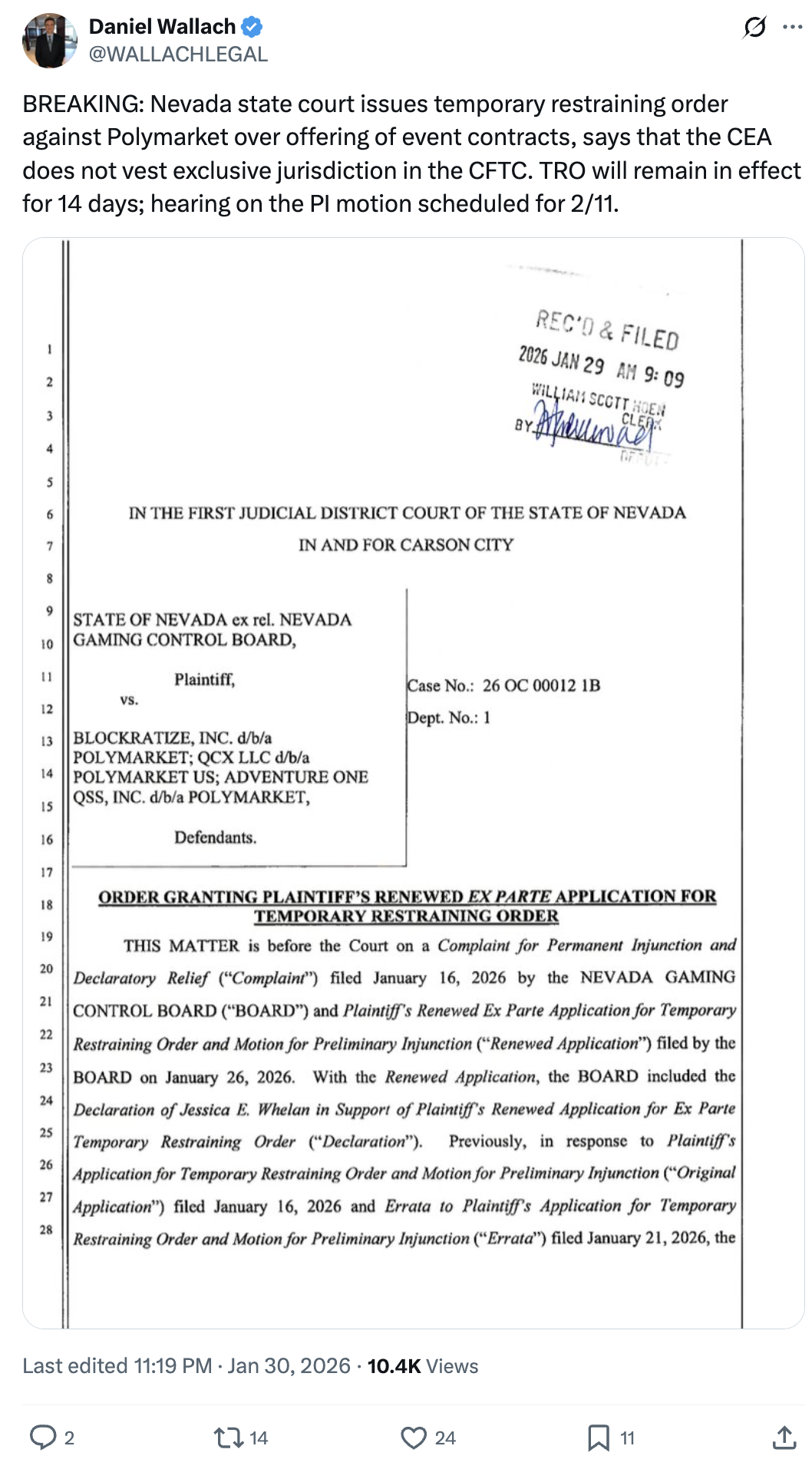 Sports and gaming attorney Daniel Wallach provided Cointelegraph with a copy of the court order. Source: Wallach
The judge noted the potential for ‘immediate’ and ‘irreparable’ damage to the state’s ability to maintain betting integrity and prevent underage gambling if the platform operates without a gaming license.
In its ruling, the court rejected Blockratize’s argument that the Commodity Exchange Act grants the CFTC exclusive jurisdiction over its event contracts, affirming that Nevada can enforce its own gaming regulations.
Cointelegraph has contacted Polymarket for comments on the situation.
Nevada Joins Tennessee in Opposing Prediction Markets
This case is part of a broader trend within the prediction markets sector. Recently, the Tennessee Sports Wagering Council demanded that Kalshi, Polymarket, and Crypto.com’s North American Derivatives Exchange cease offering sports event contracts in the state, void trades, and refund users, stating that these products fall under state gambling oversight.
Tennessee regulatory officials cited consumer protection issues, including the need for age verification and responsible gaming measures, as rationale for their decisions.
The actions taken by Nevada and Tennessee occur amidst ongoing disputes. Kalshi, recognized as a CFTC-designated contract market, has been involved in various legal battles concerning whether its offerings are considered derivatives or illegal gambling. The outcomes have varied, with some jurisdictions like Connecticut and New Jersey offering temporary protections, while others, including Nevada and Maryland, have ruled against it.
Additionally, Coinbase has initiated lawsuits against regulators in Connecticut, Illinois, and Michigan, seeking federal court judgments to affirm that prediction markets listed on a CFTC-regulated platform are governed by the Commodity Exchange Act rather than individual state gambling laws.