
Timing of Credit Stress Could Influence Bitcoin Accumulation Phase
The current US economic challenges may impact Bitcoin's price in the coming months, with analysts predicting a potential accumulation phase amid rising credit stress.


Bitcoin’s price saw significant fluctuations recently, dropping below $73,000 in light of concerning economic conditions in the U.S. Analysts are closely watching credit stress indicators as they may suggest the next accumulation phase for Bitcoin (BTC).
Key Insights:
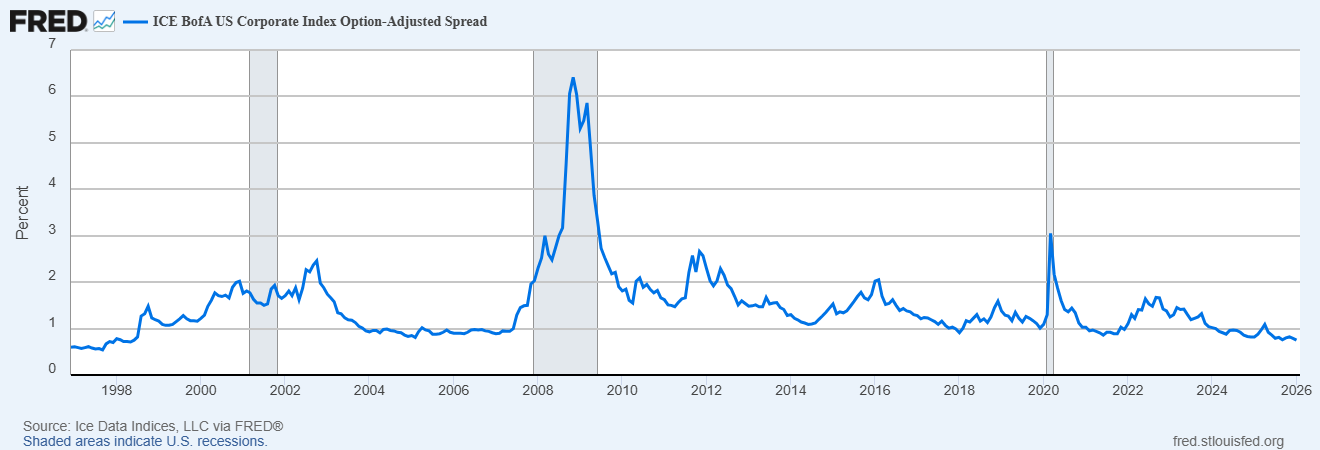
- The ICE BofA US Corporate Option-Adjusted Spread is now at 0.75, the narrowest since the late 1990s.
- The U.S. national debt exceeds $38.5 trillion, alongside a 10-year Treasury yield of 4.28%.
- While whale inflows to exchanges are increasing, the rate of on-chain profit-taking is slowing down.
 Market Analysis
ICE BofA US Corporate Index Option-Adjusted Spread. Source: Fred
Market Analysis
ICE BofA US Corporate Index Option-Adjusted Spread. Source: Fred
Conflicting Signals: Tight Credit Spreads Amid Economic Pressure
The ICE BofA Corporate Option-Adjusted Spread is a pivotal macroeconomic indicator for Bitcoin, as it reflects the additional yield that investors require for corporate bonds compared to U.S. Treasuries. Tight spreads indicate an underestimation of credit risk, contrasting with the skyrocketing U.S. government debt and rising Treasury yields.
 US Corporate Index Option Spread vs Bitcoin
US Corporate Index Option spread against Bitcoin. Source: Fred
US Corporate Index Option Spread vs Bitcoin
US Corporate Index Option spread against Bitcoin. Source: Fred
Historically, notable Bitcoin market cycles, including those in 2018, 2020, and 2022, have shown that Bitcoin typically hits a local bottom several months after credit spreads begin to widen. Analyst Joao Wedson speculates that if liquidity contracts and credit spreads rise soon, BTC could enter another accumulation phase before the broader market signs appear.
Increased Selling Activity Amidst Cooling Pressures
This week has noted heightened short-term selling from Bitcoin holders. Analyst Amr Taha reported substantial transfers of BTC to Binance by both whales and mid-term holders, including a recent deposit of 5,000 BTC from wallets holding over 1,000 BTC, echoing patterns seen last December.
 Bitcoin Binance Exchange Inflows by Holder Age
Bitcoin Binance exchange inflows by holder age. Source: CryptoQuant
Bitcoin Binance Exchange Inflows by Holder Age
Bitcoin Binance exchange inflows by holder age. Source: CryptoQuant
Conversely, broader selling pressure appears to be diminishing as data from CryptoQuant shows that the spent output profit ratio is declining towards 1, a notable low for the year. Patterns indicate that a Bitcoin market bottom could emerge within three to six months following the widening of credit spreads, while rising Treasury yields could put further strain on the credit markets, possibly leading to higher spreads by mid-2026.
 ICE BofA US Yield Options Spread vs BTC Price
ICE BofA US Yield Options Spread vs. BTC price. Source: X
ICE BofA US Yield Options Spread vs BTC Price
ICE BofA US Yield Options Spread vs. BTC price. Source: X
Note: This article is not to be taken as investment advice or a recommendation. All investments carry risk, and it is essential for each reader to conduct their own research.