





Circle Internet Group has entered into a collaboration with Polymarket to shift the prediction market’s settlement system to native USDC, moving away from the bridged stablecoin that was previously used for trading on the platform.
According to a recent announcement, Polymarket is currently utilizing bridged USDC (USDC.e) on Polygon as trading collateral. The platform intends to transition to Circle-issued native USDC over the coming months. Native USDC, regulated by Circle, can be redeemed one-for-one for US dollars, providing a more efficient and scalable alternative without depending on cross-chain bridges.
Cross-chain bridges facilitate the movement of tokens across blockchains by locking assets on one network and issuing equivalent representations on another. However, these secure communications face trade-offs in security, trust, and flexibility, which aren’t problems found in single blockchain systems.
Shayne Coplan, founder and CEO of Polymarket, stated that utilizing USDC will support a “consistent, dollar-denominated settlement standard that enhances market integrity and reliability as participation on the platform continues to grow.”
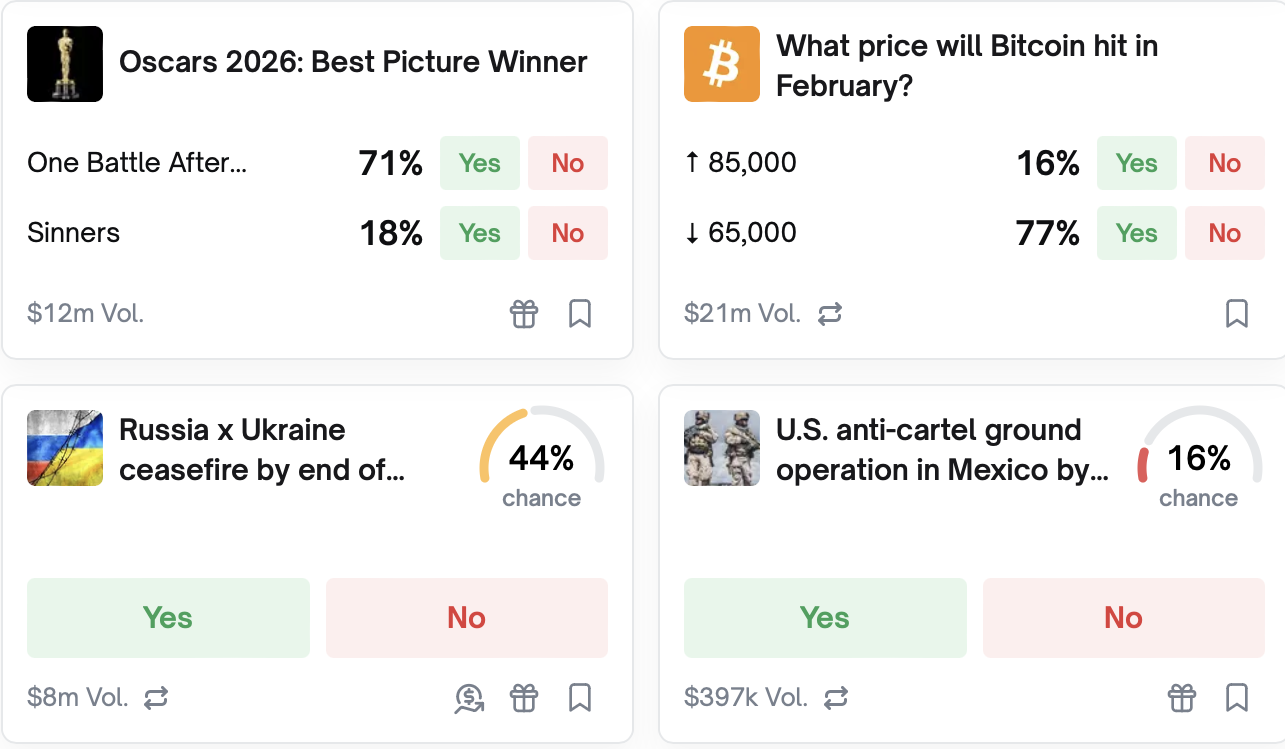 Event contracts on Polymarket. Source: Polymarket
Polymarket operates as an on-chain prediction market where users trade contracts based on real-world event outcomes using stablecoins for collateral, including forecasts on cryptocurrency prices, political happenings, and other events.
As the second-largest stablecoin, following Tether’s USDt, USDC boasts a market capitalization nearing $70.77 billion, according to Defillama data.
Rising Trends in Crypto Prediction Markets
While Polymarket and Kalshi are recognized as front-runners in prediction markets, numerous major cryptocurrency exchanges have recently ventured into this domain. Notably, in December, Gemini launched its own prediction market, Gemini Predictions, allowing event-based trading across all 50 states after receiving regulatory consent. Similarly, Coinbase announced a joint prediction market initiative with Kalshi shortly thereafter.
 Prediction market protocols. Source: Defillama
On Tuesday, Crypto.com launched its prediction markets service as a standalone venture, OG, managed by Crypto.com Derivatives North America and accessible exclusively to users in the United States. Retail platforms like Robinhood and betting service DraftKings also introduced prediction markets in 2025, intensifying competition in a field that gained significant traction during the 2024 US presidential election.
Nevertheless, concerns have emerged regarding the potential for insider trading in prediction markets. Analysts have noted instances where traders may have profited from undisclosed information or manipulated data affecting market prices. States have also posed challenges, as Kalshi faces legal scrutiny from gaming regulators in Massachusetts, New York, and several others concerning whether its event contracts qualify as gambling.