
Bitdeer Faces Significant Decline After Announcing $300 Million Debt Offering
Bitdeer Technologies Group's shares fell sharply following the announcement of its second convertible senior note offering, compounding earlier losses this year.



Shares of Bitdeer Technologies Group declined significantly on Thursday after the firm revealed a $300 million convertible senior note offering. The company stated its intention to offer $300 million in senior convertible notes with an option for buyers to purchase an additional $45 million.
This recent offering marks the company’s second convertible note issuance, following a previous $150 million offering in April 2024, which had also caused an 18% drop in its stock price. Convertible senior notes are loans convertible to shares of the issuing company’s common stock, prioritizing holders in case of bankruptcy.
The new notes are set to mature in 2032, are considered senior unsecured obligations with semiannual interest payments, and can be exchanged for cash, stock, or a mix of both.
Bitdeer plans to utilize the raised funds for data center expansion, AI cloud projects, development of cryptocurrency mining operations, and general corporate needs.
Bitdeer Stock Drops 17% on New Offering
On Thursday, Bitdeer (BTDR) saw its shares close down 17.38% to $7.94, with a slight drop in after-hours trading to $7.89. The company’s stock has now dropped 29% year-to-date and nearly 70% since its all-time high of about $26 in January 2025.
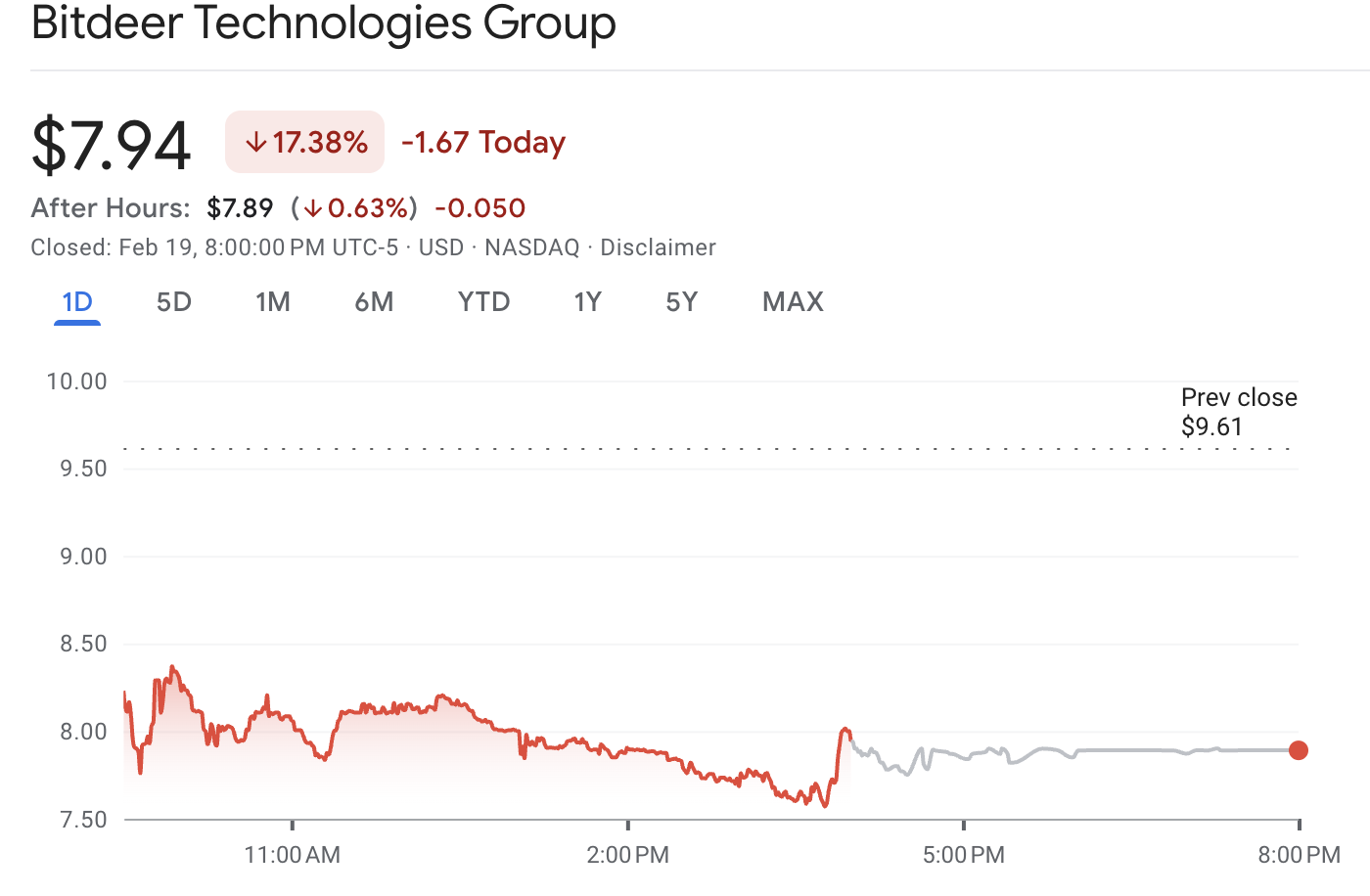 Bitdeer Stock Slide
Bitdeer experienced a significant reduction in stock value following the announcements.
Bitdeer Stock Slide
Bitdeer experienced a significant reduction in stock value following the announcements.
Convertible debt can pressure share prices as investors anticipate dilution risks: if shares rise, noteholders may convert their debts into equity, increasing the company’s share count.
Capped Call Transactions to Mitigate Dilution
Additionally, Bitdeer is conducting a concurrent registered share offering as part of a strategy to buy back some of its existing convertible notes due in 2029. To offset potential dilution, the company is implementing ‘capped call transactions,’ a type of derivative, but this measure did not prevent the stock from falling.