Bitcoin Holders Stand Firm Amid Market Uncertainty, Glassnode Reports
Bitcoin remains in a tight demand phase, yet historical trends suggest further declines are probable.



Bitcoin’s market structure has recently entered a corrective phase after dropping below a crucial valuation threshold in late January. According to Glassnode, BTC is currently trading within a defined demand area which emerged in 2024, as liquidity conditions ease. This situation is coupled with a gradual shift of BTC supply into long-term wallets linked to retail investors, while activity on exchanges has diminished.
Defending the $60,000 Support Level
In its recent report, Glassnode noted that Bitcoin’s price experienced a downward shift after falling beneath its true market average of approximately $79,000 in January. The price has since found some footing within a narrow range between $60,000 and $69,000, bolstered by medium-term holders, primarily due to the age of the coins accumulated during much of 2024.
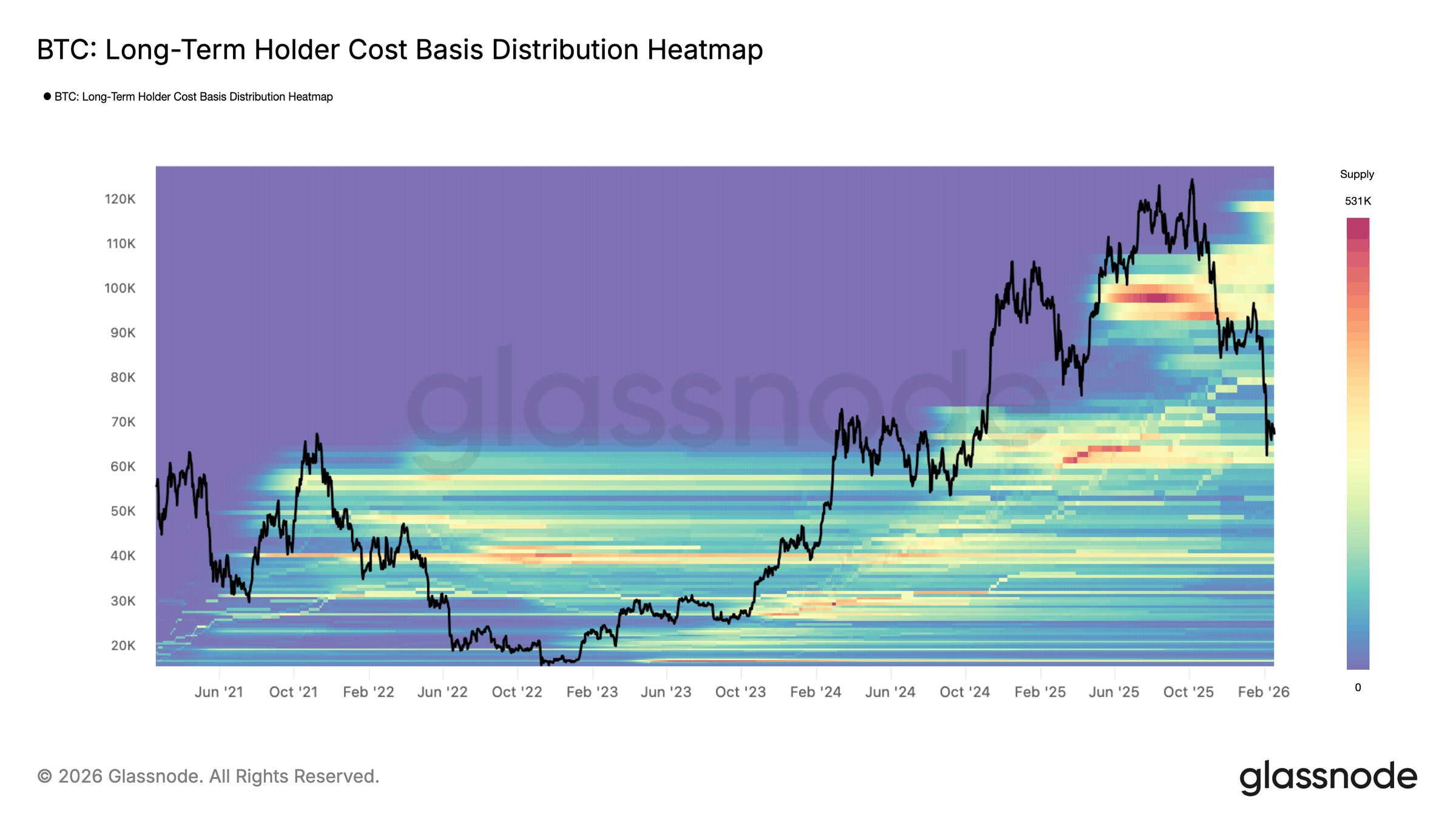 BTC long-term holder cost basis distribution heatmap. Source: Glassnode
Coins acquired within this range have matured for over a year, creating significant support against active selling pressure.
Market analyst Ardi remarked on a social platform, “We’re trading within the same $53-73K range that took 245 days to establish last year. Consider the volume that transited through this zone. It’s currently the most contested area on BTC’s chart.”
Translation: The analyst highlights the historical importance of the current trading range for Bitcoin.
Slowing Accumulation Despite Decreased Activity
Data from CryptoQuant reveals that Bitcoin balances in accumulating wallets have risen to over 4 million BTC, an increase from around 2 million BTC in early 2024, demonstrating a consistent absorption of supply. Retail-linked wallets have boosted their holdings by 850,000 BTC, while other wallets engaging in consistent BTC accumulation have reached 1.27 million BTC, despite price drops in 2026. In contrast, inflows from centralized exchange addresses have notably lowered, with recent activity remaining considerably less compared to previous years, leading to reduced liquidity and slowed trading activity.