


Crypto treasury executives are advocating for the Basel Committee on Banking Supervision (BCBS) to revisit the exorbitant 1,250% risk weight assigned to Bitcoin and other cryptocurrencies under the Basel III guidelines.
This steep 1,250% capital requirement necessitates that banks must cover any Bitcoin (BTC) they hold with a 1:1 ratio of approved collateral, effectively making Bitcoin a more expensive asset to hold compared to others.
In contrast, cash, physical gold, and government bonds have a 0% risk weight in the same regulatory framework.
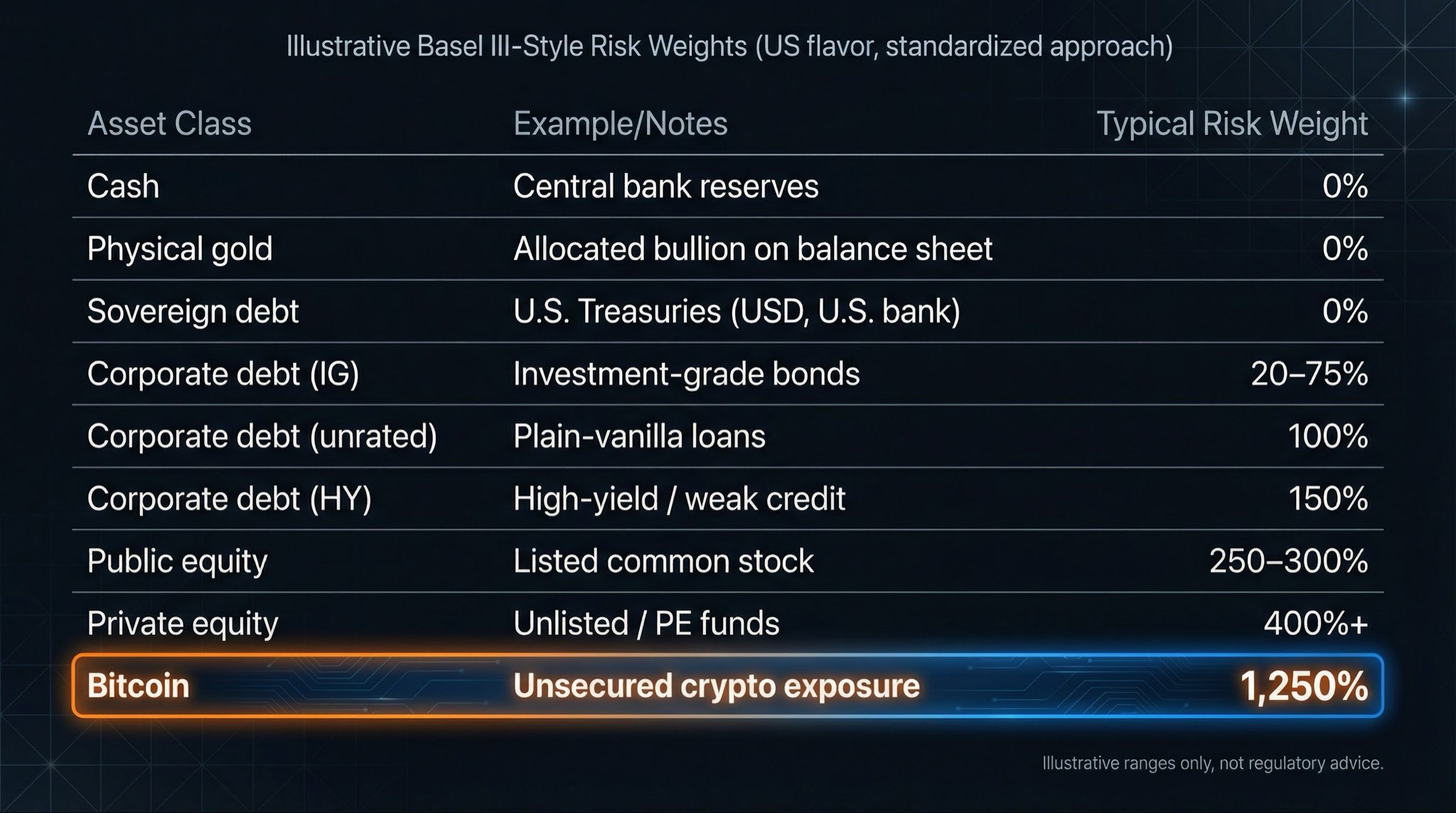 Image depicting Basel III risk weights
Basel III risk weights for different asset classes held by banking institutions. Source: Jeff Walton
Image depicting Basel III risk weights
Basel III risk weights for different asset classes held by banking institutions. Source: Jeff Walton
“If the US wants to be the ‘crypto capital’ of the world, the banking regulations need to change. Risk is mispriced,” stated Jeff Walton, the Chief Risk Officer at Bitcoin treasury firm Strive.
These Basel III regulations hinder banks from holding cryptocurrencies because of the high costs correlated with these digital assets versus standard reserve requirements. This scenario diminishes a bank’s return on equity, which is vital for profitability, as pointed out by Chris Perkins, president of investment firm CoinFund.
Basel Responds to Criticism from the Crypto Sector
The Basel Committee initially proposed the current risk weightings in 2021, positioning BTC and similar cryptocurrencies in the highest risk tier with a massive 1,250% weight.
In 2024, they solidified the capital requirements they outlined in that proposal, facing significant resistance from the crypto industry.
 Phong Le, CEO of Strategy, urges Basel III reforms
Phong Le, CEO of Strategy, advocates for reviewing Basel III crypto risk weightings. Source: Phong Le
Phong Le, CEO of Strategy, urges Basel III reforms
Phong Le, CEO of Strategy, advocates for reviewing Basel III crypto risk weightings. Source: Phong Le
Recent communications indicate that the committee is contemplating easing these capital requirements for digital assets in response to the growing stablecoin market, which is approaching a $300 billion valuation.
Erik Thedéen, the chair of the BCBS, has acknowledged that a fresh perspective may be necessary for the current 1,250% risk weight on cryptocurrencies, which might indicate potential adjustments to reserve standards.