


The Senate of the United States voted Thursday to adopt an amendment to the 21st Century Road to Housing Act. This amendment prohibits the Federal Reserve from creating a central bank digital currency (CBDC).
The CBDC ban is set to stay in force until December 31, 2030, as specified in the amendment within the legislation. The bill achieved a significant majority, passing with a vote of 89-10, and it reads:
“The Board of Governors of the Federal Reserve System or a Federal Reserve Bank may not issue or create a central bank digital currency or any digital asset that is substantially similar to a central bank digital currency, directly or indirectly through a financial institution or other intermediary.”
However, this legislation does not prevent any dollar-backed digital currencies that are “open, permissionless, and private,” such as stablecoins.
According to US Treasury Secretary Scott Bessent and former President Donald Trump, dollar-pegged stablecoins could help maintain the influence of the US dollar. Meanwhile, Trump and several Republican lawmakers remain firmly opposed to CBDCs.
Lawmakers Critique CBDCs as Authoritarian Technology
Over 30 lawmakers in the US signed a letter on March 6, urging the Senate to implement a permanent ban on CBDCs rather than just a temporary halt.
Representative Ralph Norman remarked, “A CBDC would give unelected bureaucrats unprecedented power over Americans’ finances and threaten basic economic freedom.”
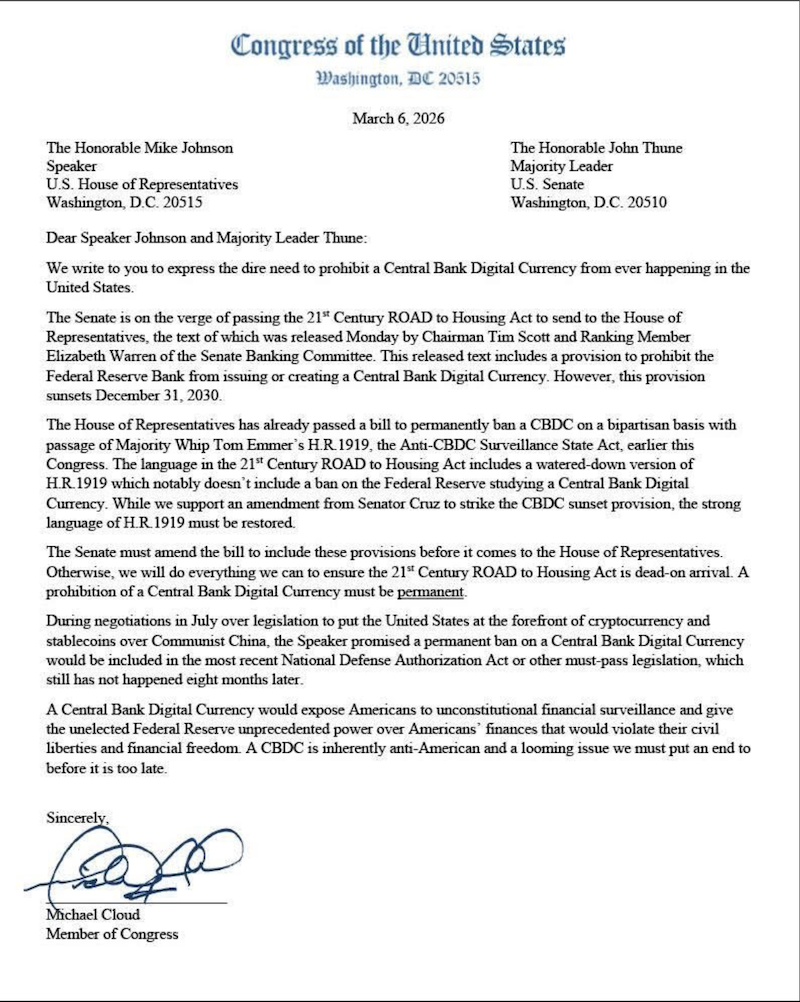 Letter from lawmakers
Representative Warren Davidson, a consistent critic of CBDCs, recently suggested that regulated dollar-pegged stablecoins pose similar risks of surveillance.
Hedge fund manager Ray Dalio also expressed concerns that CBDCs could enhance government oversight of individual finances, stating:
“There will be no privacy, and it’s a very effective controlling mechanism by the government.”
Dalio noted that CBDCs are unlikely to yield interest, making them inherently vulnerable to government interference, such as taxation or freezing of funds.
For further insights, see the magazine article GENIUS Act reopens the door for a Meta stablecoin, but will it work?.