



Onchain commodity trading is proving it’s more than just a temporary trend, yet issues with liquidity are still hindering its ability to compete with traditional trading platforms.
In a striking sign, Hyperliquid’s HIP-3 market recorded an all-time high on March 23, hitting approximately $5.4 billion in perpetual futures volume across commodities and macro assets. Silver took the lead with $1.3 billion in activity, followed by WTI crude oil with $1.2 billion, Brent crude at $940 million, and gold at $558 million. Notably, equity indices like the Nasdaq and S&P 500 also experienced considerable volumes.
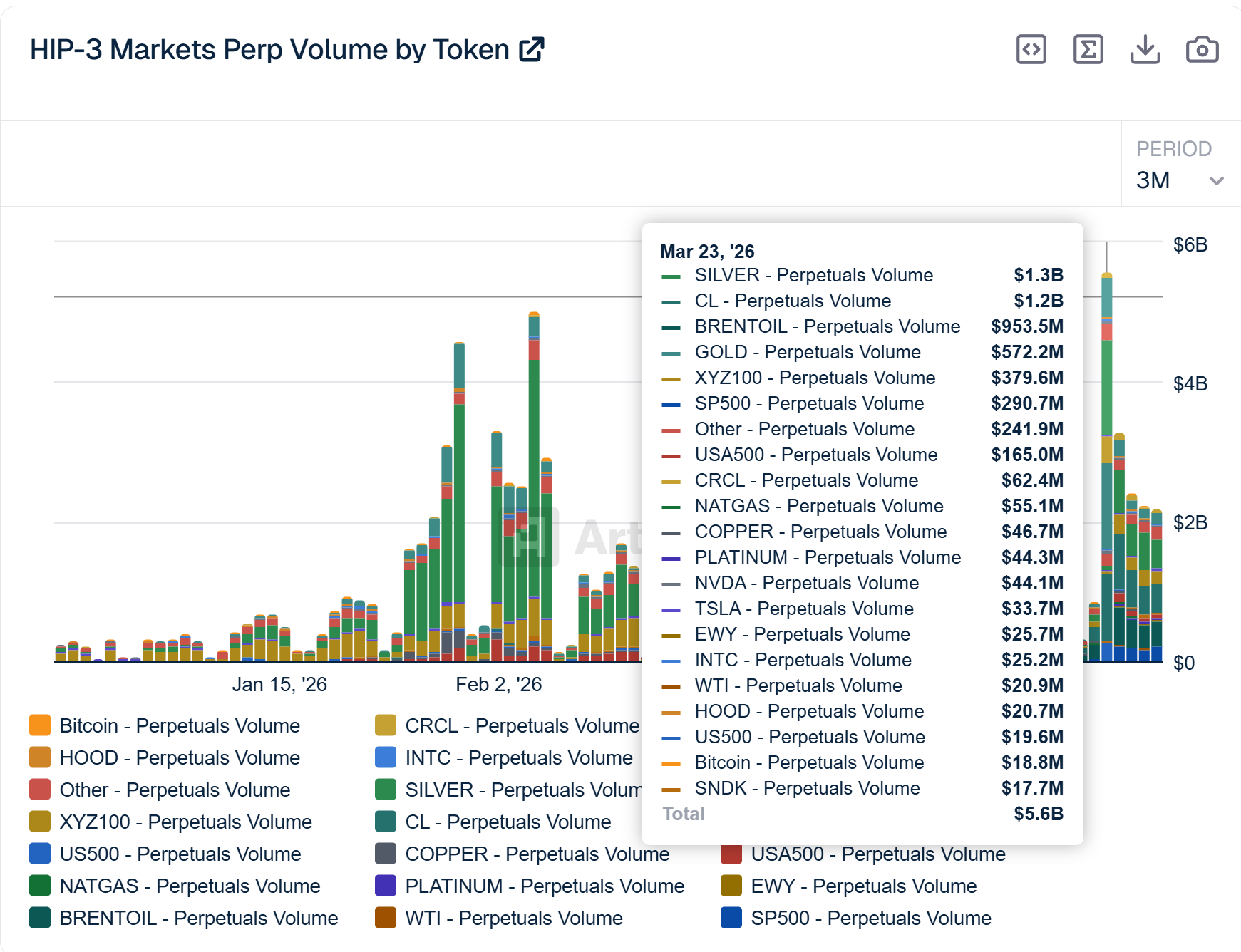 HIP-3 volume data. Source: Artemis
Participants in the industry indicate that this surge signifies the increasing demand for macro exposure in onchain trading. Iggy Ioppe, Chief Investment Officer at Theo, stated: “Previously, onchain commodity futures were predominantly used by crypto-focused investors, but that narrative is shifting considerably. The real indicator is not just the volume itself, but when it occurs and who is engaging in these trades.”
Ioppe pointed out that onchain oil futures are now registering over $1 billion in daily volume during weekends when traditional exchanges are closed, a shift that is partly attributed to individual investors from traditional finance accessing these markets through personal accounts. “Geopolitics doesn’t pause over the weekend, and markets are evolving to accommodate that reality,” he added.
Additionally, the ability to trade 24/7 has positioned onchain platforms with a critical advantage. The substantial 49-hour gap between traditional market closing on Friday and reopening on Sunday allows decentralized platforms to serve as one of the few venues where traders can respond to macro developments in real-time.
This dynamic influences how prices are determined outside normal trading hours, though a majority of liquidity remains concentrated in traditional markets. Ioppe commented: “For now, onchain serves as the price discovery layer while other markets are inactive. Traditional finance still provides deeper liquidity when trade volume is significant.”
Oil futures at the CME typically experience between 1 million to 4.5 million contracts traded daily, equating to around $100 billion to $300 billion in notional volume.
According to Sergej Kunz, co-founder of 1inch, traditional platforms still retain their dominance regarding liquidity and the quality of execution. He observed, “Deeper liquidity and narrower spreads remain the fundamental challenges. Without these, onchain markets find it hard to execute large trades without causing price fluctuations, limiting the participation of institutional investors.”
Other challenges such as the reliability of pricing and the evolution of market structures and regulations have also been highlighted by Shawn Young, Chief Analyst at MEXC Research. Young remarked that commodity tokenization reveals signs of significant behavioral shifts, albeit still at an early stage, with liquidity and price aggregation gaps that still require attention.
Despite existing limitations, trading is steadily growing. Kunz noted, “The general trend is evident: traders are becoming increasingly comfortable with gaining macro-style exposure onchain.” Gold and oil are leading this charge, but market participants foresee similar patterns emerging across various asset classes as volatility trends shift.
Ioppe concluded that trading activity in onchain futures markets will likely continue to increase as trust is established in weekend pricing. As more traders begin to rely on these markets during off-hours, trading volume will rise. This momentum, in turn, fosters growing open interest, reinforcing market credibility and attracting more inflow.
Related articles: