

Five Solo Victories in Bitcoin Mining in 2025
At a time when Bitcoin mining is primarily conducted by large corporations utilizing advanced hardware, the probability of a solo miner achieving success is extremely low. However, the year 2025 saw a remarkable twist.
Five solo miners, working independently from large mining pools, each managed to successfully mine a block, bringing in rewards that exceeded $350,000. While such occurrences are typically rare, they underscore the unpredictable yet inclusive essence of Bitcoin, where even individual miners can sometimes excel.
Bitcoin mining validates transactions and fortifies the Bitcoin network by solving intricate cryptographic challenges. Dominated by massive mining operations with specialized equipment, solo mining—where an individual tries to solve a block—is an exceptionally uncommon accomplishment.
In 2025, mining difficulty reached unprecedented heights. For a solo miner using average hardware, the chances of success are comparable to winning a major lottery. As the total hash rate of the Bitcoin network rises, the likelihood of a small miner with just a few terahashes per second succeeding in mining a block is drastically low.
For example, a miner with a machine rated at 100 TH/s, such as a high-performance Antminer S19, has less than 0.0001% chance of resolving a block each day. Thus, achieving a block reward can take from several months to several years for a solo miner.
Did you know? Bitcoin mining commenced with Satoshi Nakamoto’s genesis block on January 3, 2009, which was mined as the first block, awarding 50 BTC. Since then, every miner has contributed to this foundational proof-of-work legacy.
Noteworthy Solo Mining Achievements of 2025
Each solo Bitcoin miner successfully mined a block on their own, receiving rewards around $350,000, marking a significant milestone in Bitcoin’s mining landscape.
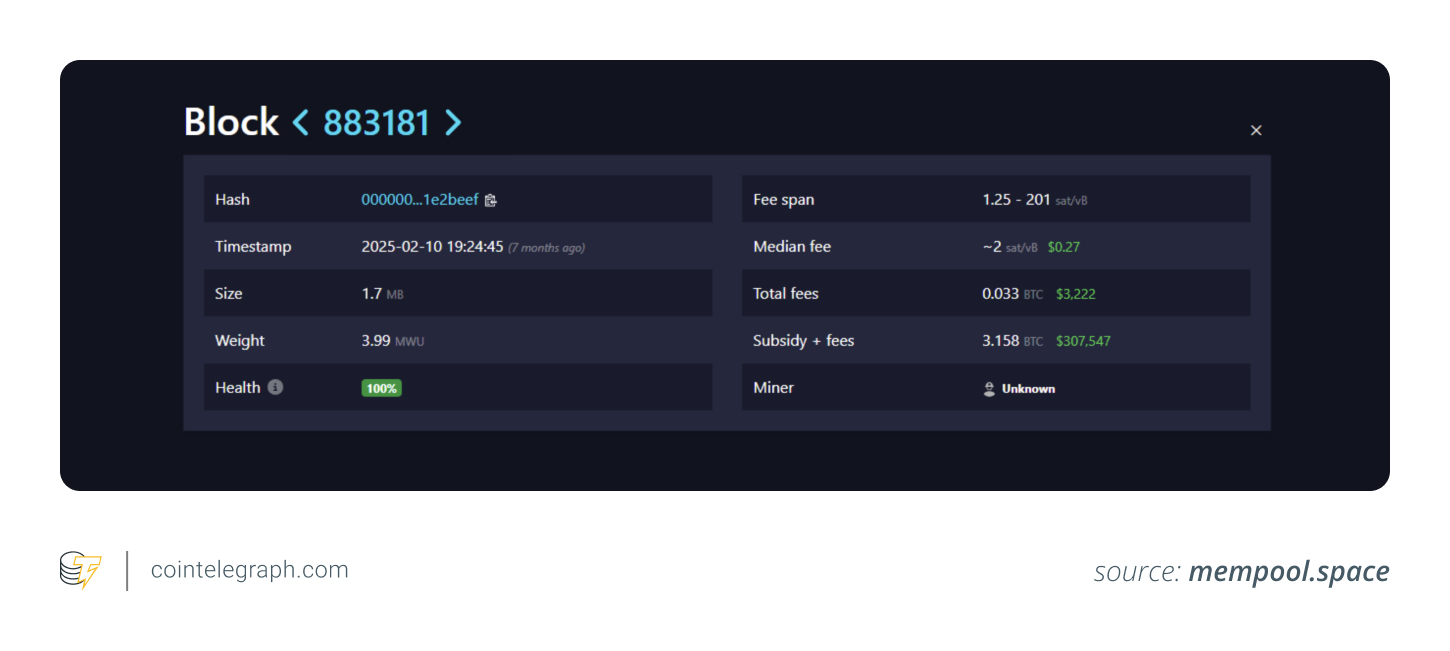
Block 883,181 (February 10, 2025)
An independent miner claimed a block by mining 3.125 BTC, worth over $300,000 at the time. The miner completed block 883,181, which processed 3,071 transactions, resulting in a total reward of 3.15 BTC.
Block 883,181
Block 903,883 (July 4, 2025)
On July 4, 2025, another solo miner with merely 2.3 PH/s mined block 903,883 and was awarded 3.173 BTC, approximately $349,028 at that time. The odds of such a success were about one in 2,800 per day, or roughly once every eight years for that hash rate.
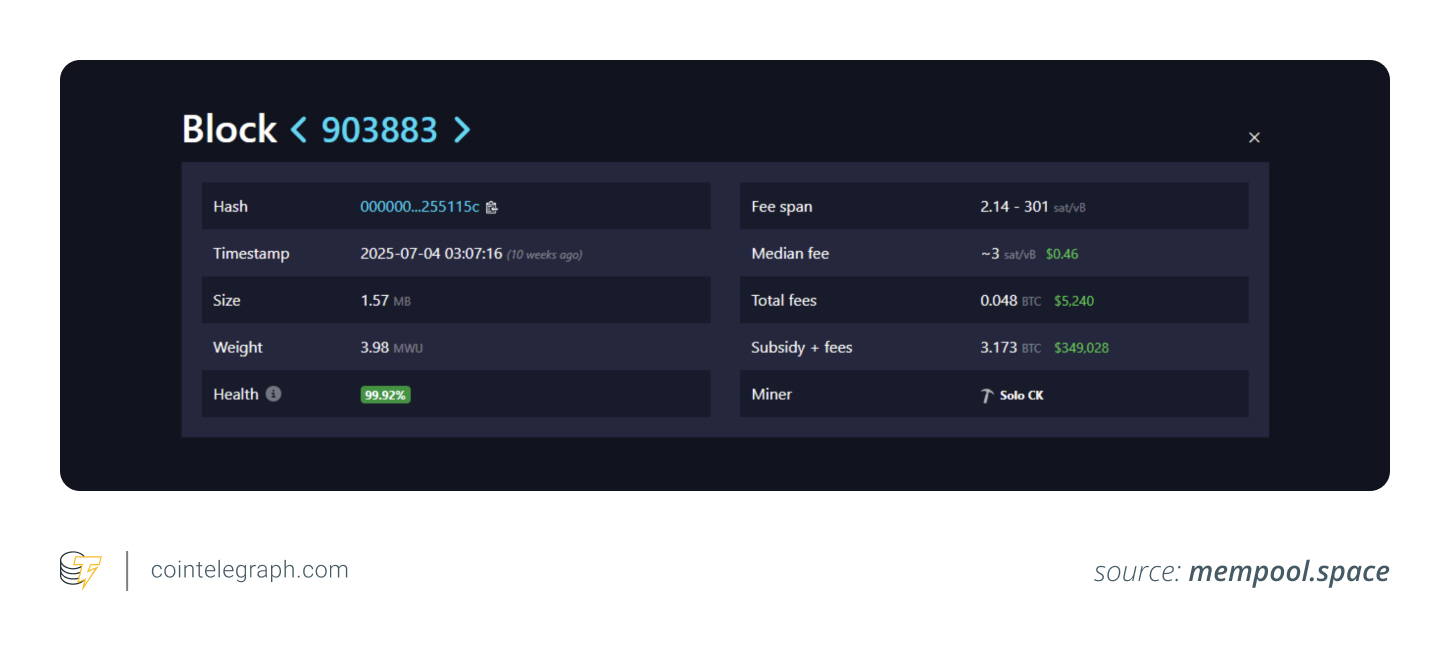 Block 903,883
Block 907,283 (July 26, 2025)
An additional independent miner, utilizing the Solo CKPool service, successfully mined a block, receiving 3.125 BTC, valued at $372,773 at that moment. This block numbered 907,283 included 4,038 transactions and generated $3,436 in transaction fees.
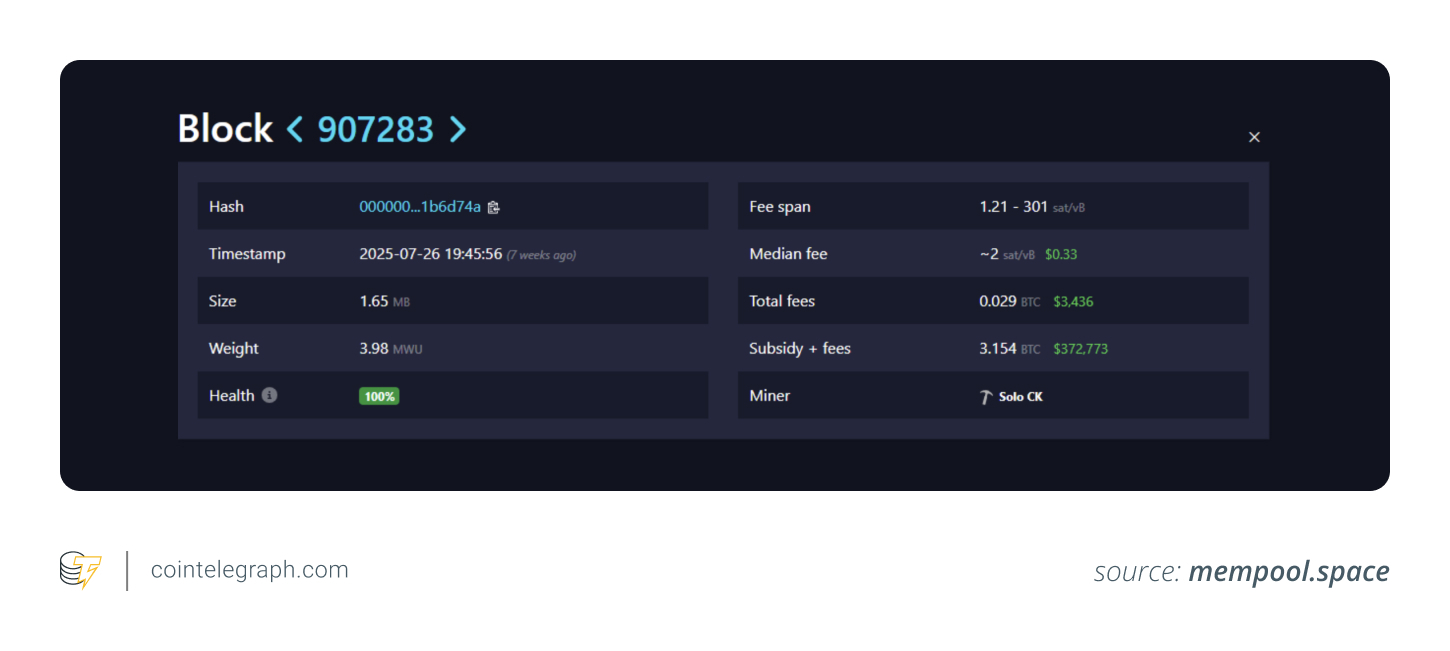 Block 907,283
Block 910,440 (August 17, 2025)
On August 17, another miner using Solo CKPool managed to mine block 910,440, claiming 3.125 BTC and about 0.012 BTC in transaction fees, which added up to approximately $373,000 in Bitcoin rewards. This block consisted of 4,913 transactions, totaling $1,455.
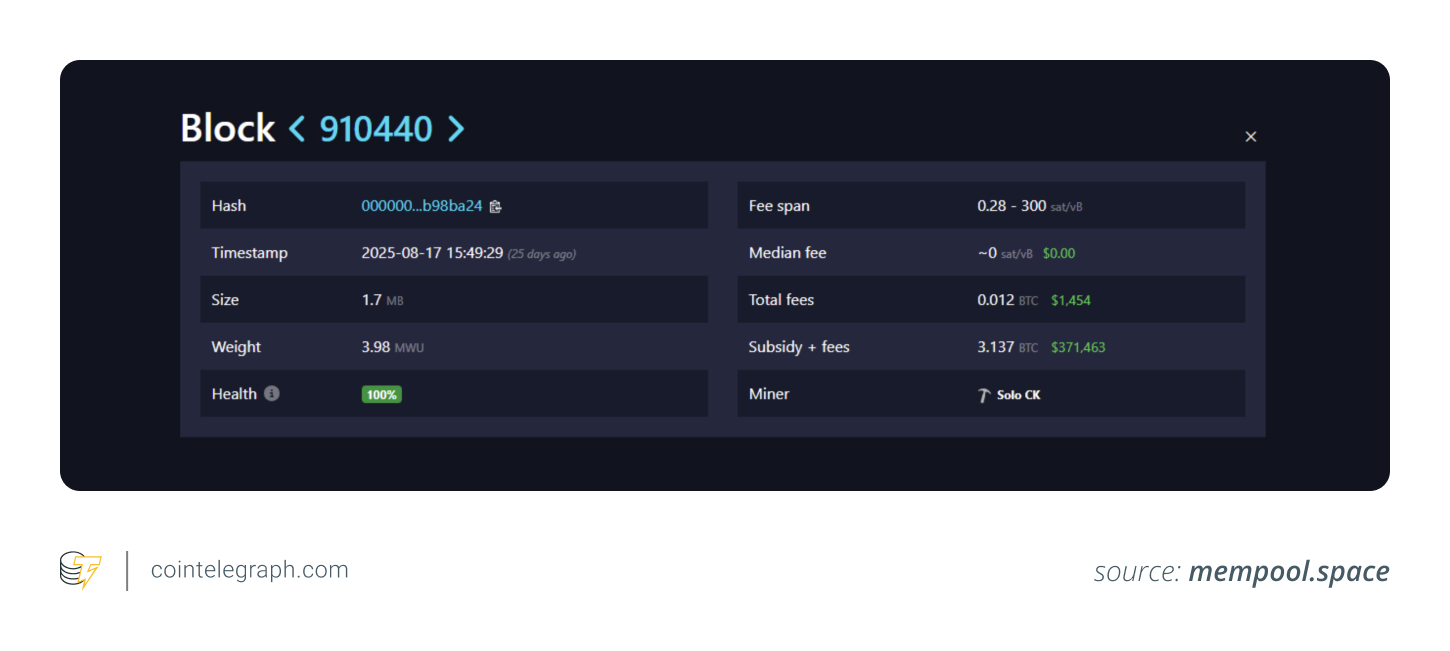 Block 910,440
Block 913,632 (September 8, 2025)
On September 8, 2025, a solo Bitcoin miner mined block 913,632, earning 3.14 BTC, then valued at $348,111. This total comprised the standard 3.125 BTC block reward along with an extra 0.019 BTC from transaction fees. The block handled 1,956 transactions.
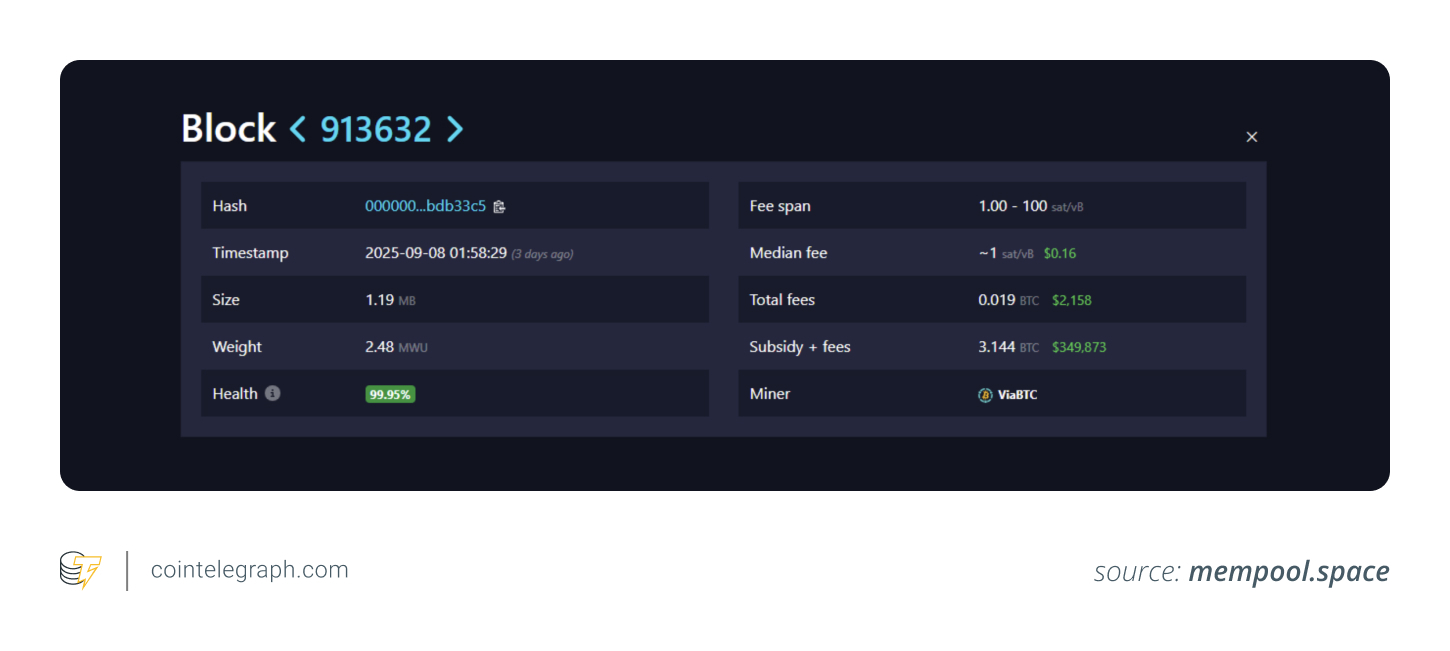 Block 913,632
These achievements illustrate how, despite the predominance of large-scale mining operations, individual miners can defy the odds, gaining substantial rewards. Collectively, these victories exemplify Bitcoin’s distinct blend of unpredictability, decentralization, and opportunity.
Did you know? Bitcoin block rewards reduce roughly every four years. In 2024, the reward decreased to 3.125 BTC per block. These halvings generally lead to price rallies, creating anticipation across the crypto market and highlighting the interplay between mining and Bitcoin’s monetary policy.