
SOL Struggles Amid Declining Market: Is Solana Losing Its Edge?
SOL has underperformed against other altcoins, facing declining on-chain activity and revenues.



Key takeaways:
- SOL has fallen behind in the altcoin market as both transaction fees and DApp revenues drop, indicating weaker demand within the Solana network.
- Momentum in the market has shifted towards competitors like Base, Arbitrum, Polygon, and BNB Chain, suggesting a lower likelihood of a short-term recovery for SOL.
Solana’s native token, SOL, has seen a 32% decline since November, which is significantly worse than the broader altcoin market’s 21% drop. This disparity has raised concerns among SOL proponents, especially as more investment vehicles and companies incorporate SOL as a reserve strategy in their portfolios.
Traders are pondering what changes may be necessary for SOL to regain a stable rising trend.
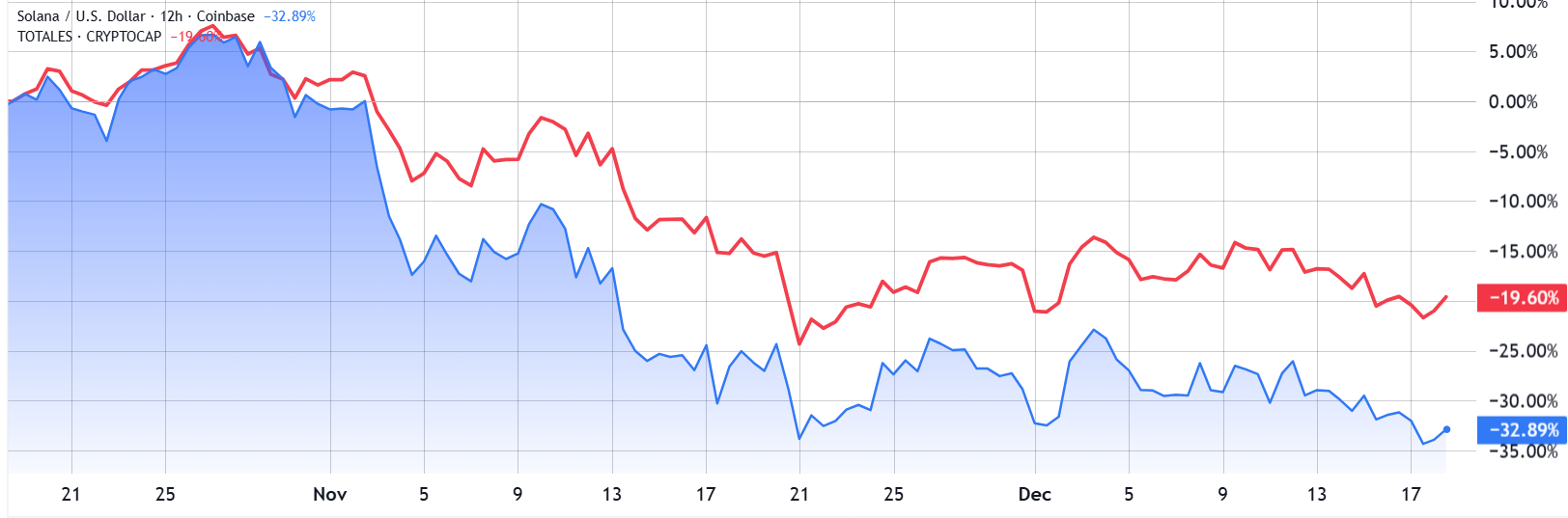 SOL/USD Comparison
SOL/USD (blue) vs. total crypto capitalization (red). Source: TradingView
SOL/USD Comparison
SOL/USD (blue) vs. total crypto capitalization (red). Source: TradingView
The Solana ETF landscape in the United States has amassed $636 million in assets since the REX-Osprey SOL+Staking ETF launched in July. Moreover, companies like Forward Industries, Solana Company, and Sharps Technology have collectively acquired 20.35 million SOL, now valued over $2.5 billion.
Furthermore, the native staking on Solana contributes to limiting available SOL for sale. Currently, almost 68% of circulating supply is delegated to the network’s proof-of-stake mechanism, an increasing trend observed over recent months. Staking yields on Solana can surpass 6% as the supply remains inflationary to cover validator operating costs.
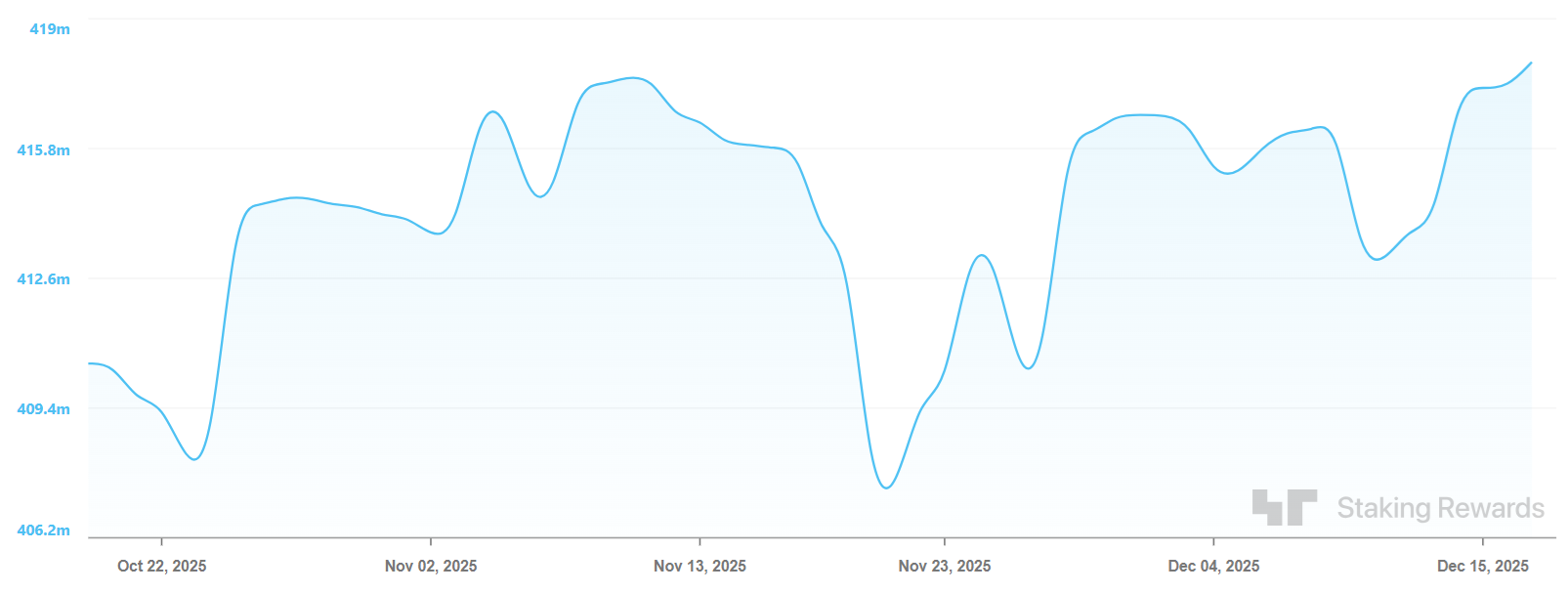 Native Staked SOL
Native staked SOL on the Solana network. Source: StakingRewards
Native Staked SOL
Native staked SOL on the Solana network. Source: StakingRewards
The total staked SOL increased from 410 million to 418 million over a two-month span, a continuation of trends seen since March. Consequently, SOL’s retreat towards the $120 mark appears closely linked to lowered expectations for Solana’s network activity. Broader adoption trends may be gravitating toward rival platforms or alternative solutions not reliant on direct blockchain settlements.
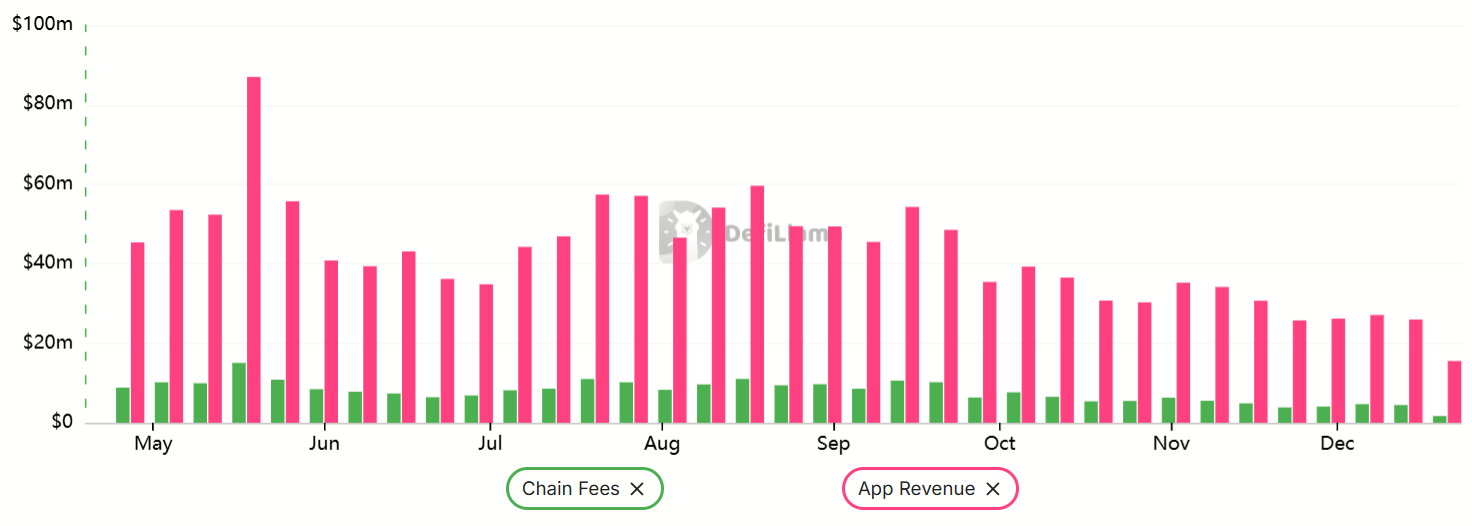 Solana Network Activity
Solana network weekly chain fees vs. DApps revenue, USD. Source: DefiLlama
Solana Network Activity
Solana network weekly chain fees vs. DApps revenue, USD. Source: DefiLlama
Onchain activity within Solana has been steadily declining since August, with weekly network fees dropping to $4.5 million from $7 million two months ago. Decentralized applications (DApps) in Solana have also faced a 30% revenue decline during this period, now at $26 million per week. While Solana’s functionality diminishes, activities on competing networks have grown.
Solana Compared to Ethereum’s Layer 2 Ecosystem
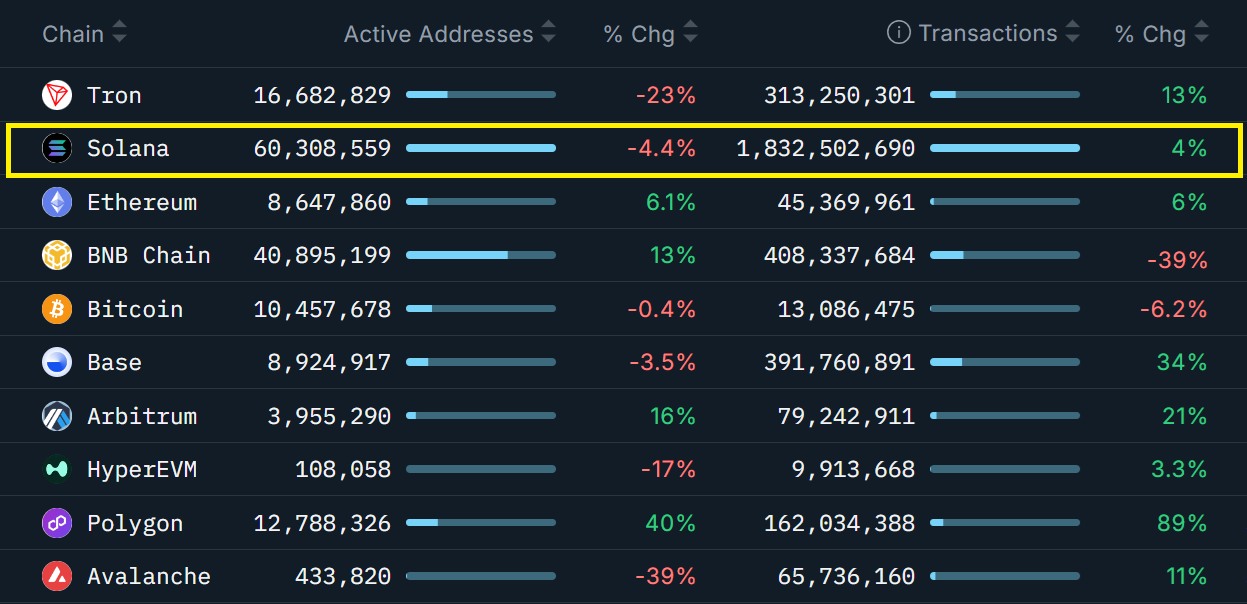 Transaction Counts
Top blockchains ranked by 30-day fees. Source: Nansen
Transaction Counts
Top blockchains ranked by 30-day fees. Source: Nansen
Monthly transaction activity saw a modest 4% uptick for Solana and 6% for Ethereum. In contrast, there was a notable 34% increase on Base, 21% on Arbitrum, and 89% for Polygon. Even Tron, a rival to Solana, witnessed a 13% transaction increase over the past 30 days. The Ethereum layer-2 sector continues to grow, providing affordable transaction fees and surpassing Solana’s total value locked (TVL) of $8.5 billion.
Investors in SOL have become increasingly cautious, particularly considering the recent successes of DApps on the BNB Chain, such as Aster and Four-meme. The backing from the world’s largest cryptocurrency exchange facilitates easier access for these projects to developer resources, marketing, and user base.
SOL is unlikely to reduce its performance gap relative to the broader altcoin market without a definitive shift in Solana on-chain activity. Whether competition arises from other blockchain networks or traditional financial tech companies like Nasdaq, which has plans for 23-hour trading, the outlook for sustained positive momentum in SOL seems constrained.
This article serves only as general information and should not be construed as financial advice. Always conduct personal research before making investment decisions.