
Assessment of China's Bitcoin Mining Crackdown Hyperbole
Recent data indicates that the impact of the alleged Bitcoin mining crackdown in China's Xinjiang region may have been exaggerated.


Overview
Recent discussions of a significant Bitcoin mining crackdown in China’s Xinjiang region have caused considerable anxiety within the cryptocurrency sphere. However, findings from TheMinerMag suggest that the repercussions may not be as severe as initially thought.
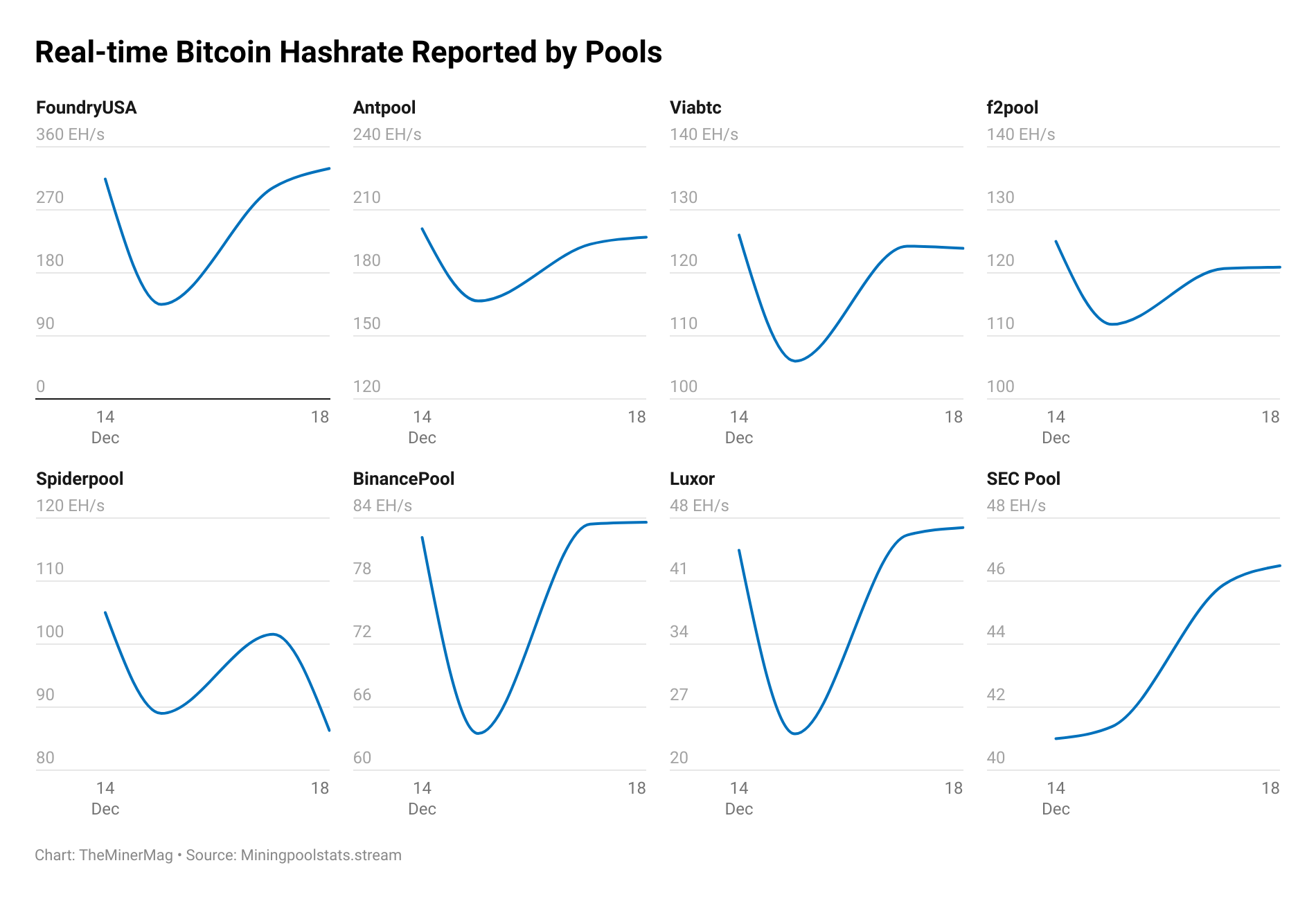
According to a Miner Weekly report, the Bitcoin network had a temporary decline in hashrate related to events in Xinjiang, coinciding with power restrictions in the U.S.
Most major mining operations recovered swiftly, only experiencing a net decline of about 20 exahashes per second, a stark contrast to the 100 EH/s losses previously reported. This indicates that the disruptions were likely short-lived.
“That points to a largely temporary disruption rather than a sustained, region-specific shutdown,” the report noted.
This difference is crucial when evaluating Bitcoin’s overall security and miner engagement. Larger, prolonged hashrate dips can influence block generation and mining complexity, hence, misrepresenting a localized event could distort perceptions of international mining trends and amplifies geopolitical risks.
 Mining Activity
Source: TheMinerMag
Mining Activity
Source: TheMinerMag
Data shows that the most significant pool-level declines during the Monday disruption primarily originated from North America, with Foundry USA reporting a loss of approximately 180 EH/s.
While mining pools originating from China noted declines of about 100 EH/s, the assertion of the entire decline being due to Xinjiang could be misleading.
What Stemming the Disruption?
Rumors of a renewed crackdown in Bitcoin mining in China emerged following statements from Jianping Kong, a former executive at Canaan, claiming that some operations in the Xinjiang area had ceased.
Initially, social media estimates suggested up to 400,000 to 500,000 mining rigs might have been deactivated.
 Source: Kevin Zhang
Source: Kevin Zhang
Source: Kevin Zhang
Further investigation suggests the outages were more related to compliance or operational challenges rather than a widespread enforcement campaign.
Despite the brief fluctuation in hashrate, Bitcoin mining linked to China has been rising again in recent years, despite a nationwide ban in 2021. Research from CryptoQuant indicates that up to 15% to 20% of the global Bitcoin mining capacity continues to operate from China.
Xinjiang is particularly appealing to miners due to its vast and cost-effective energy resources. Meanwhile, local governments have made significant investments in data center infrastructure, enabling facilities to lease idle capacity to Bitcoin miners, providing a buffer against fluctuating demand from external computing requirements.
Related: Crypto Biz: Mining weakness tests Bitcoin’s market cycle