



Arthur Hayes, co-founder and former CEO of the crypto exchange BitMEX, expressed in a recently published Substack essay that the Federal Reserve’s newly introduced “reserve management purchases” (RMP) program is essentially a rebranded variant of quantitative easing.
Hayes argues that through the acquisition of short-term Treasury bills and liquid recycling in money markets, the Fed is indirectly financing government spending while sidestepping the political backlash associated with quantitative easing. The officials have characterized this initiative as a benign liquidity strategy.
“The RMP is a thinly disguised way for the Fed to cash the government’s checks. This is highly inflationary both financially and in terms of real goods and services,” he stated.
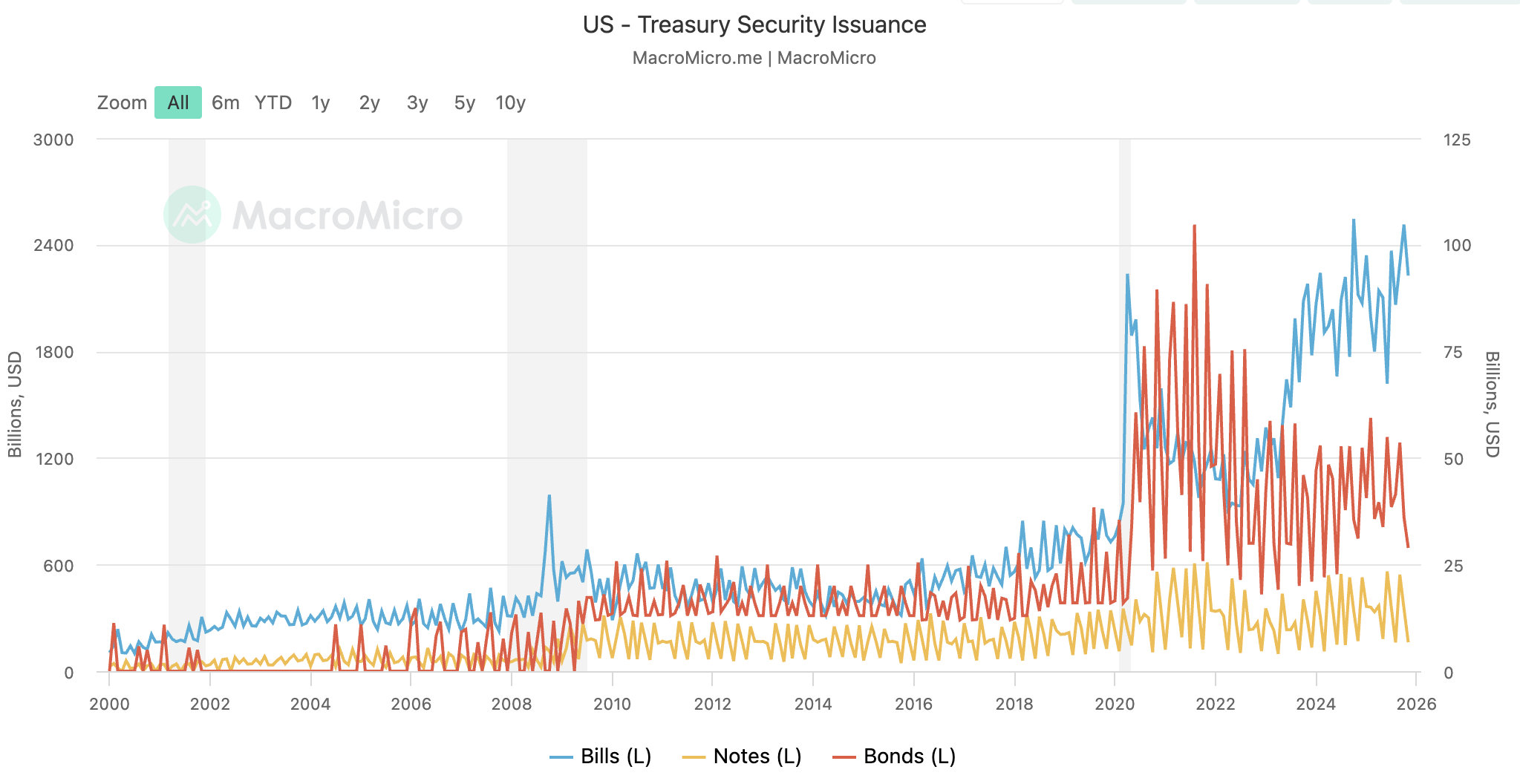 US Treasury issuance by maturity
US Treasury issuance by maturity. Source: MacroMicro
Hayes believes that policies like the RMP inflate fiat liquidity and, in his assessment, favor scarce assets such as Bitcoin, gold, and silver.
“I appreciate quantitative easing as it leads to increased money supply, and fortunately, I hold financial assets like gold, gold/silver mining stocks, and Bitcoin that appreciate faster than the rate of fiat money generation,” he stated.
He cautioned, however, that those lacking assets would be adversely affected since money creation diminishes purchasing power, weakens wages in relation to prices, and redistributes wealth towards asset holders.
“Unfortunately, for the majority of humanity at present, monetary inflation undermines their dignity as productive members of society,” he lamented. “When the government deliberately devalues the currency, it severs the connection between energy input and economic output.”
Related:
Bitcoin rebounds on Japan rate hike as Arthur Hayes sees dollar at 200 yen
On December 10, the Federal Open Market Committee (FOMC) cut interest rates by 25 basis points and announced the purchase of short-term Treasury securities, a measure that Fed Chair Jerome Powell indicated was “entirely aimed at maintaining sufficient reserves” and is separate from the stance of monetary policy.
According to the Fed, the initial purchases would touch roughly $40 billion in the first month and may remain elevated for several months to alleviate near-term challenges in money markets, especially concerning seasonal variations like tax payments.
In spite of the rate cut and the short-term Treasury purchases announcement, analysts indicated that Powell’s mixed signals could hinder a sustained Bitcoin rally until the rate cutting resumes in 2026.
On December 10, the Bitcoin price hovered around $92,695, based on Yahoo Finance data. At the time of writing, it was approximately trading at $87,300.
As of now, Polymarket traders are predominantly pricing a steady Fed policy in January, estimating a 77% chance of no changes, with a 21% likelihood of an additional 25 basis points cut, while more significant changes are deemed highly improbable.
 Odds of Fed rate cut in Jan.
Odds of Fed rate cut in January. Source: Polymarket
Powell’s tenure is expected to conclude in May 2026. US President Donald Trump, who has openly advocated for the next Fed chair to implement aggressive interest rate cuts, is getting ready to interview potential candidates, with National Economic Council Director Kevin Hassett being widely regarded as the frontrunner.