
Stablecoin Market Faces Slowdown Amid Regulatory Pressures and Rising Yields
The stablecoin landscape is adjusting to new regulations and economic factors, leading to a significant halt in its supply growth.


After experiencing rapid growth, the global stablecoin market has now stabilized, shifting towards a phase of consolidation due to new regulations, liquidity issues, and rising Treasury yields. According to Jimmy Xue, co-founder of Axis, institutional issuers are now facing increased compliance costs and stricter frameworks in the US and Europe, leading to a reduction in net issuance.
During a recent note shared with Cointelegraph, Xue expressed his observations about the effects of the new regulations, emphasizing that while regulatory advancements have been made, higher standards for reserves are impacting the speed of stablecoin issuance. Meanwhile, competing yields from US Treasurys have diminished the appeal of stablecoins that do not provide direct returns.
“The recent plateau in stablecoin market cap is primarily a consolidation phase following the explosive growth of 2025,” said Xue, highlighting the adjustments made by institutional investors in response to the tighter liquidity requirements under the US GENIUS Act and the European Union’s Markets in Crypto-Assets framework.
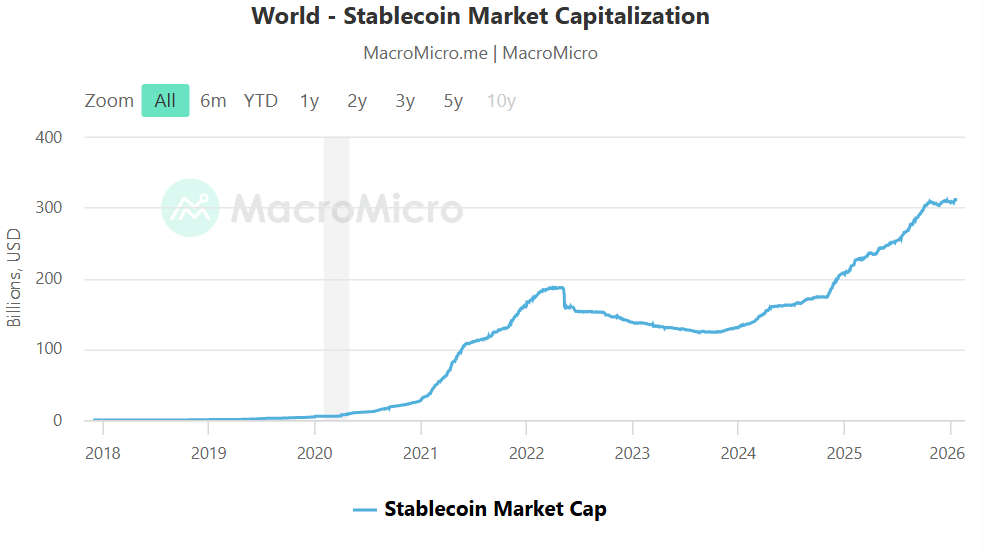
The overall stablecoin market appears to be flat, estimated to have a circulating supply of around $310 billion since October, a sharp contrast to its doubling rate seen between January 2024 and early 2025.
 Market illustration
The stablecoin market hovers around $310 billion. Source: Macro Micro
As liquidity constraints came into play, the supply growth in stablecoins faced a plateau after a significant market correction. Various factors, including increased risk-averse sentiment, have contributed to the lack of growth, with traders becoming hesitant to issue new stablecoins amidst uncertainties.
Concurrently, discussions on yield-bearing stablecoins have intensified in the US, as banking organizations have initiated lobbying efforts to regulate or entirely ban them due to concerns over competition with traditional financial products.
Jeremy Allaire, CEO of Circle, challenged these assertions, stating that the banking sector’s apprehensions regarding stablecoin yields are unfounded and described the situation as “totally absurd” during a presentation at the World Economic Forum in Davos.
Related: Crypto’s 2026 investment playbook: Bitcoin, stablecoin infrastructure, tokenized assets