Crypto Trading Volumes Hit Lowest Levels of 2024 as Demand Dwindles
Trading volumes in the cryptocurrency market have drastically decreased, reflecting a significant drop in investor engagement and liquidity.



Crypto Trading Volumes Drop to Lowest Levels of 2024 Amid Reduced Demand
Spot crypto trading volumes have plummeted by 50% since October as market liquidity continues to dry up and investor engagement weakens.
Current Market Situation
According to analysts, crypto trading volumes on major exchanges decreased from approximately $2 trillion in October to $1 trillion by the end of January, indicating a significant disengagement from investors and diminished demand. Bitcoin (BTC) is now 37.5% lower than its peak in October due to a liquidity shortage and a prevailing risk-averse sentiment affecting trading volumes.
“Spot demand is drying up,” said CryptoQuant analyst Darkfost on Monday, attributing this correction largely to the liquidation event on October 10.
Between October and now, spot volumes on major exchanges have halved. Binance’s Bitcoin trading volume, for instance, dropped from $200 billion in October to around $104 billion.
“This contraction in volumes has brought the market back to levels among the lowest observed since 2024, suggesting a clear disengagement from investors in the crypto market and, consequently, weaker demand.”
Despite these challenges, other factors are also exacerbating the situation. Market liquidity is under pressure due to stablecoin outflows from exchanges and an approximate $10 billion decline in the stablecoin market cap.
A Necessary Shift in the Market
Justin d’Anethan, head of research at Arctic Digital, suggested that short-term market risks for BTC remain predominantly macro-driven. He stated:
“Uncertainty around Kevin Warsh’s hawkish stance as Fed chair could mean fewer or slower rate cuts, a stronger dollar, and higher real yields, which all pressure risk assets, including crypto.”
Although there is still a narrative supporting Bitcoin as a hedge against inflation, moving forward will depend on factors such as renewed ETF inflows, more accommodative pro-crypto legislation, or economic data that prompts the Fed to adjust its policies.
“It might be a bitter medicine, but the recent move feels ultimately necessary and healthy to clear out leverage, tone down speculation, and force investors to reconsider valuations.”
Current Market Indicators
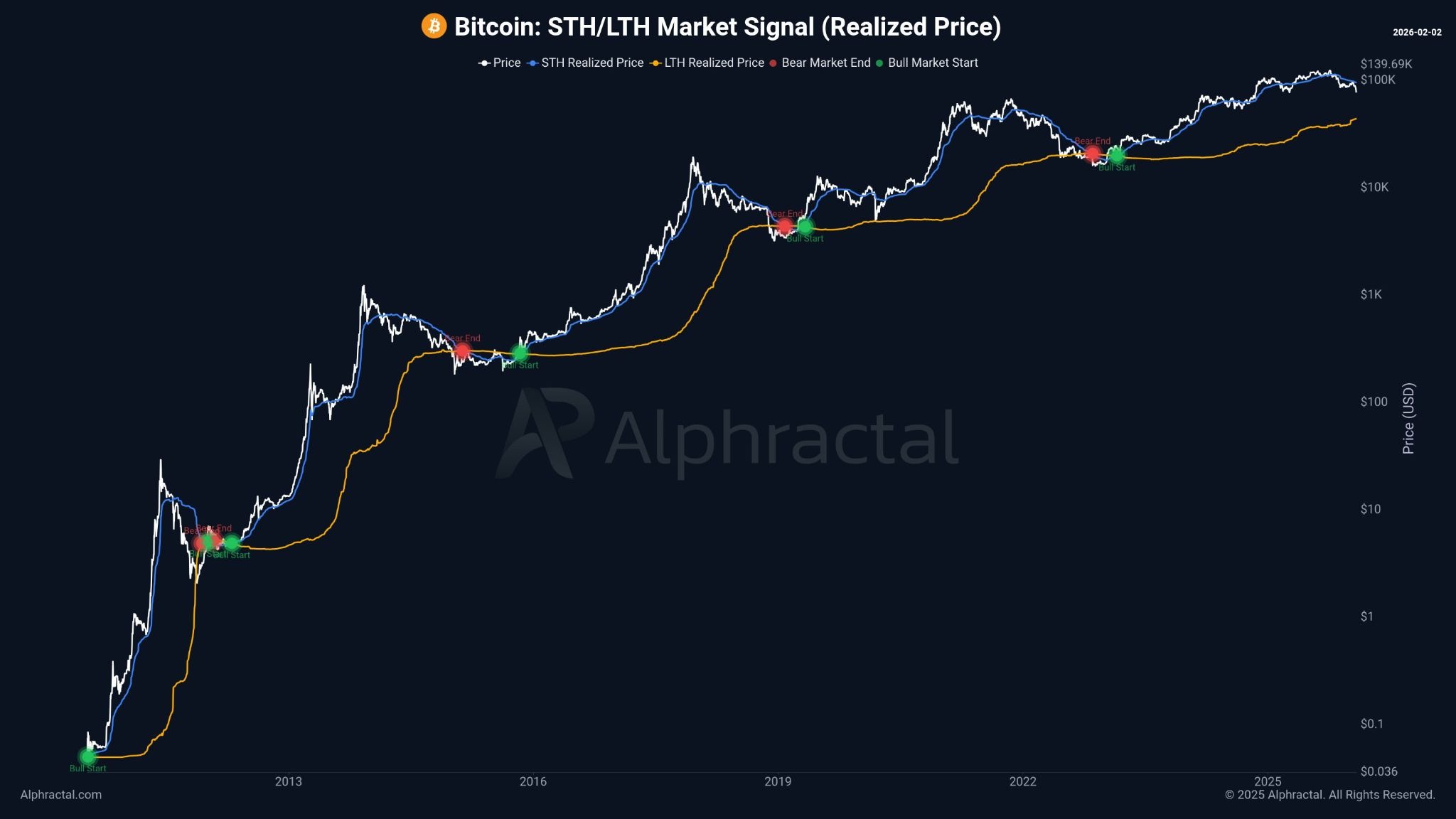
Joao Wedson, founder and CEO of Alphractal, highlighted the conditions required to identify a Bitcoin price bottom. He mentioned that the current situation allows short-term holders (STH) to realize losses, but not yet for long-term holders (LTH).
He explained that bear markets conclude when STH realized price dips below LTH realized price, marking the beginning of a potential bull market when the reverse occurs. Currently, STH realized prices exceed LTH, and a drop below the $74,000 key support could signal a bear market for Bitcoin.
Market Signals
Bull and bear market signals from STH/LTH realized price. Source: Alphractal
Related Articles: