Bitcoin Just Escaped Its Worst Monthly Decline: What Lies Ahead for April?
Bitcoin narrowly avoided the sixth consecutive red month, offering a glimmer of hope as the market looks forward to new trends in April.


After another tumultuous month driven by geopolitical tensions in the Middle East, Bitcoin managed to finish with a slight gain and narrowly avoided a sixth-month decline.
The attention now shifts towards April and the second quarter of the year, prompting inquiries into what investors should anticipate moving forward.
March’s Performance
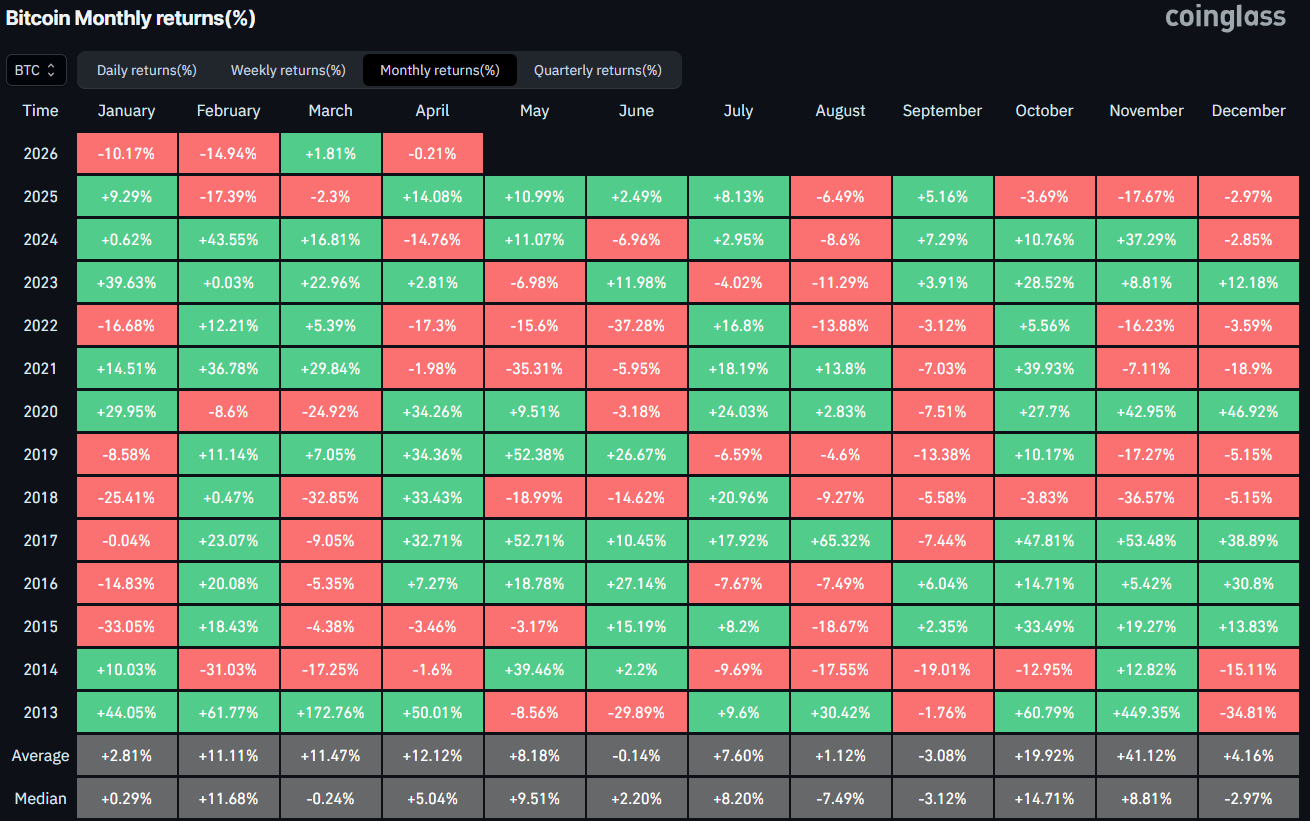
Despite reaching a record high earlier in October, the month ended negatively, setting off a troubling trend for Bitcoin. Data from CoinGlass reveals that after a 3.7% drop in October, Bitcoin fell by more than 17.5% in November, followed by 3% in December, and had continuous declines in January and February, 2026.
This extended Bitcoin’s time in the bearish market, as March was poised to determine whether it would match a historically poor streak of negative performance from August 2018 to January 2019. Ultimately, a last-minute increase on March 31 to $68,000 allowed Bitcoin to conclude March with a minimal 1.8% rise.
Bitcoin Monthly Returns. Source: CoinGlass
Regardless, the quarterly results were grim. Following a 23.07% decline in Q4 2025, Bitcoin suffered another 22.2% drop in the first quarter of 2026, its worst quarterly performance since the 2018 downturn.
What’s Ahead?
Historically, Bitcoin has seen positive trends in April, particularly notable in 2013 (surging 50%), and numerous double-digit gains between 2016 and 2020. In a discourse with CryptoPotato, Lacie Zhang, a research analyst from Bitget Wallet, commented on the future outlook:
“The April outlook for crypto remains cautiously optimistic, even as markets navigate a complex mix of geopolitical uncertainty, including ongoing ceasefire discussions in the Middle East alongside the risk of further escalation. Bitcoin and stablecoins are continuing to function as key channels for capital movement out of the region, with relatively low correlation to traditional assets and increasing room for institutional accumulation. This dynamic suggests that, despite headline-driven volatility, underlying demand remains intact and structurally supportive.”
Zhang also outlined targets for Bitcoin and Ethereum for Q2. If tensions in Iran escalate, Bitcoin might test the $55,000 mark while Ethereum could languish at yearly lows around $1,500. Conversely, a peaceful resolution could lead to Bitcoin exceeding $90,000 and Ethereum hitting $2,700.
Another potential catalyst for price movement is the anticipated CLARITY Act, though the chances of its passage this year hover around 40%-60%.